
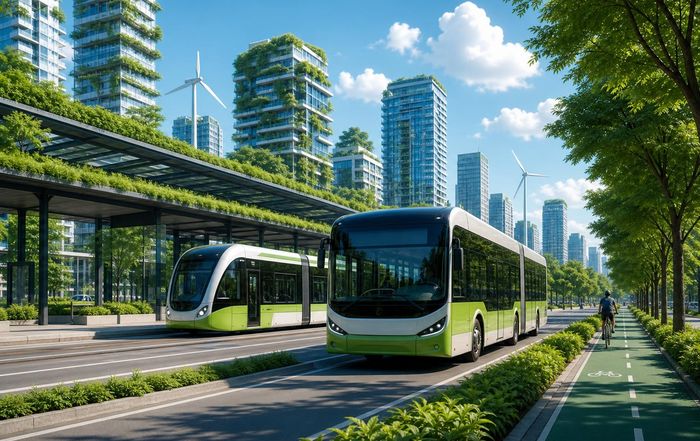
How Public Transport Supports Sustainable City Growth
Rethinking Urban Mobility for a Sustainable Future
Across the world's cities, from New York and London to Singapore and São Paulo, public transport is emerging as one of the most powerful levers for building sustainable, resilient and inclusive urban environments. As climate science, urban economics and public health research converge, a clear narrative has taken shape: well-planned public transport systems do far more than move people; they shape how cities grow, how healthy their residents are, how businesses compete and how communities connect.
For Eco Natur, whose wildlife, loving individuals are deeply engaged with sustainable living, circular economies and nature-positive development, public transport is a critical bridge between personal lifestyle choices and systemic change. While individuals can adopt sustainable living practices at home, it is the collective investment in shared mobility that enables cities to reduce emissions, protect wildlife habitats at the urban fringe, and create thriving, people-centered neighborhoods.
Public Transport and the Climate Imperative
Transport is a major driver of global greenhouse gas emissions. According to the Intergovernmental Panel on Climate Change (IPCC), the sector accounts for roughly 23 percent of global energy-related CO₂ emissions, with road vehicles responsible for the majority of that total. Data from the International Energy Agency (IEA) and the World Resources Institute (WRI) consistently show that private cars and light-duty vehicles dominate urban transport emissions in high-income countries and are rapidly increasing in many emerging economies.
Public transport, especially when powered by low-carbon electricity or clean fuels, offers one of the most effective ways to cut these emissions while maintaining mobility and economic opportunity. Urban rail systems, such as metros and light rail, typically emit far less CO₂ per passenger-kilometer than private cars, especially when powered by renewable energy sources. Studies compiled by C40 Cities and the International Association of Public Transport (UITP) indicate that a full bus can replace 30 to 50 private cars on the road, depending on local vehicle occupancy, which directly reduces fuel consumption, congestion and air pollution.
As cities invest in cleaner grids and renewable energy, the climate benefits of electric buses, trams, and metro networks increase significantly. Initiatives such as the Zero Emission Bus Rapid-deployment Accelerator (ZEBRA) in Latin America and the growing fleets of electric buses in cities like Shenzhen, Santiago and Oslo demonstrate how technology, policy and finance can align to decarbonize mobility in a way that supports broader sustainability goals. Readers who wish to explore the wider context of energy transitions can learn more about renewable energy policy and trends.
Compact Cities, Less Sprawl and Protected Ecosystems
Public transport does not only cut emissions; it also shapes how cities expand. Car-dependent urban planning tends to produce low-density sprawl, which consumes large areas of land, fragments wildlife habitats and increases infrastructure costs. By contrast, robust metro, tram and bus networks enable compact, mixed-use development where people can live, work, study and shop within walking or cycling distance of high-capacity transit corridors.
This pattern, often described as transit-oriented development (TOD), has been widely studied by organizations such as UN-Habitat and the World Bank. Evidence from cities including Copenhagen, Vancouver and Freiburg shows that concentrating growth around stations reduces per-capita land use, preserves green belts and agricultural land, and lowers infrastructure costs per resident. The European Environment Agency and OECD have both highlighted that compact, transit-served cities are more resource-efficient and better positioned to protect biodiversity than sprawling metropolitan regions.
For the Eco Natur community, which is deeply concerned with biodiversity and wildlife, this connection is crucial. When cities grow upward rather than outward, they reduce pressure on forests, wetlands and coastal ecosystems, leaving more space for nature to thrive. This does not eliminate all conflicts between urban expansion and habitat protection, but it provides a foundation for more balanced land-use planning that considers ecological corridors, urban green spaces and nature-based solutions. Those interested in the science behind land use and biodiversity can explore assessments by the Intergovernmental Science-Policy Platform on Biodiversity and Ecosystem Services (IPBES) and resources from the IUCN on urban biodiversity strategies.
Cleaner Air and Healthier Communities
Air pollution remains a major public health challenge in many cities, with transport emissions contributing significantly to particulate matter (PM₂.₅), nitrogen oxides (NOₓ) and ozone precursors. The World Health Organization (WHO) reports that exposure to ambient air pollution is linked to millions of premature deaths annually, primarily from cardiovascular and respiratory diseases.
Replacing large numbers of private vehicles with efficient, clean public transport can substantially improve urban air quality. Evidence from cities that have introduced low-emission zones, expanded bus rapid transit (BRT), or electrified bus fleets shows measurable reductions in NO₂ and particulate levels along key corridors. London's Ultra Low Emission Zone, for example, has been associated with significant declines in roadside NO₂ concentrations, as documented by the Greater London Authority and independent health researchers, although attributing exact percentages solely to public transport improvements is complex due to overlapping policies.
Improved air quality translates into better public health outcomes, fewer hospital admissions and lower healthcare costs. The Health Effects Institute and Lancet Commission on Pollution and Health have both emphasized that transport policies are central to controlling urban air pollution. When integrated with walking and cycling infrastructure, public transport systems also promote physical activity by encouraging people to walk to stations and stops, which supports cardiovascular health and mental well-being. Readers can explore broader connections between environment and well-being through Eco Natur's focus on health and sustainable lifestyles.
Social Inclusion, Equity and Accessible Cities
Sustainable city growth is not only about emissions and land use; it also concerns equity, access and social cohesion. Public transport is often the backbone of inclusive urban mobility, particularly for low-income residents, youth, older adults and people who cannot or choose not to drive.
Research from UN-Habitat, the World Bank and OECD consistently shows that reliable, affordable public transport expands access to jobs, education, healthcare and cultural life, which in turn supports social mobility and reduces inequality. In many cities across Europe and Asia, fare policies, integrated ticketing and targeted subsidies help ensure that public transport remains accessible to vulnerable groups, while investments in step-free access, real-time information and safety measures make systems more usable for people with disabilities.
In the United States, initiatives such as the Federal Transit Administration's focus on "transit-oriented communities" and equity-oriented funding criteria aim to connect historically underserved neighborhoods with high-quality transit. Similar approaches can be found in Canada's major metropolitan regions, Australia's capital cities and emerging transit programs in African and South American urban centers. While outcomes vary and challenges remain, the direction of travel is clear: sustainable city growth requires mobility systems that serve everyone, not just those who can afford a car.
For Eco Natur, which explores the intersection of sustainability and the economy, this equity dimension is central to understanding how public transport underpins resilient, inclusive urban economies that leave no one behind.
Economic Vitality, Productivity and Local Business
Efficient public transport networks are powerful drivers of urban economic growth. By reducing travel times, easing congestion and expanding labor markets, they enable businesses to access a wider pool of employees and customers, while allowing workers to reach more job opportunities. Studies summarized by the World Bank, International Transport Forum (ITF) and Brookings Institution suggest that well-designed transit investments can generate substantial economic benefits through increased productivity, higher property values near stations and reduced logistics costs.
In cities such as Hong Kong, Singapore and Tokyo, integrated rail and bus systems have enabled extremely high levels of economic activity within relatively compact areas, demonstrating how transit can support dense clusters of innovation, services and commerce. European cities with strong public transport and cycling cultures, including Amsterdam, Zurich and Stockholm, consistently rank high in global competitiveness indices, with analysts from WEF and IMD noting the role of efficient mobility in their success.
Local businesses often benefit from vibrant, walkable districts around transit hubs, where foot traffic supports retail, hospitality and cultural venues. Transit-oriented development can, however, raise concerns about gentrification and displacement. Research by urban institutes and community organizations shows that inclusive planning, affordable housing policies and community land trusts can help ensure that the economic gains from transit investment are shared more equitably. Those interested in the business dimension of sustainability can learn more about sustainable business practices and how mobility infrastructure fits into broader ESG strategies.
Public Transport, Sustainable Lifestyles and Consumption
Public transport also plays a subtle but significant role in shaping daily habits, consumption patterns and the cultural norms of mobility. When high-quality transit is available, reliable and comfortable, it becomes easier for individuals and families to adopt sustainable lifestyles that are less centered on car ownership and high-carbon consumption.
Living in a transit-rich neighborhood often correlates with smaller living spaces, closer proximity to local shops and services, and greater reliance on walking and cycling. These patterns can reduce per-capita energy use, encourage more frequent shopping at local markets and support businesses that prioritize organic and sustainably produced food. Researchers at institutions such as the Institute for Transportation and Development Policy (ITDP) and ICLEI - Local Governments for Sustainability have documented how integrated mobility systems support local economies, reduce wasteful infrastructure and foster a culture of shared resources.
Public transport also aligns with the principles of zero-waste and circular living. Shared vehicles make more efficient use of materials and land than private car fleets, while transit-oriented neighborhoods can more easily support centralized recycling, composting and reuse initiatives. Readers who wish to delve deeper into the connections between mobility, waste reduction and circular economy models can consult analyses by the Ellen MacArthur Foundation and research hosted by Circle Economy.
Technology, Innovation and the Future of Urban Mobility
In the last decade, rapid advances in technology have transformed how public transport is planned, operated and experienced. Real-time data, mobile ticketing, integrated journey planners and open data platforms have made it easier for passengers to navigate complex networks and combine modes, from metro lines and buses to shared bikes and e-scooters.
Organizations such as UITP, ITF and the World Economic Forum have highlighted how Mobility-as-a-Service (MaaS) platforms are beginning to integrate public transport with shared mobility providers, enabling users to plan, book and pay for multi-modal journeys through a single interface. While the exact environmental impact of ride-hailing and micromobility services remains debated-some studies suggest they can increase vehicle kilometers traveled if not integrated well-there is growing consensus that public transport must remain the backbone of urban mobility, with new services playing a complementary role.
Electrification is another major trend, with cities across Europe, Asia and the Americas committing to phase out diesel buses and adopt electric or hydrogen fuel cell fleets. Reports from the IEA, BloombergNEF and International Council on Clean Transportation (ICCT) indicate that electric buses are becoming increasingly cost-competitive over their lifetimes, especially when powered by clean electricity. However, the pace of adoption varies widely, and questions remain regarding battery supply chains, raw material sourcing and end-of-life recycling, which must be addressed to ensure that the shift to electric mobility aligns with broader environmental and social goals.
For Eco Natur, these technological shifts raise important questions about design, materials and lifecycle impacts, which connect directly to the platform's great focus on sustainable design and innovation. As cities experiment with autonomous shuttles, on-demand transit and advanced traffic management systems, ensuring that innovation serves sustainability, equity and resilience will be a central challenge.
Public Transport and the Plastic-Free, Low-Waste Agenda
At first glance, public transport may seem tangential to the fight against plastic pollution and waste, but in practice the connections are significant. Car-centric infrastructure often encourages dispersed retail formats such as big-box stores and drive-through outlets, which are strongly associated with high levels of single-use packaging and disposable products. By contrast, compact, transit-oriented neighborhoods support local markets, refill shops and services that can more easily adopt reusable systems.
Many transit authorities are beginning to address waste directly by phasing out single-use plastics in stations and vehicles, improving recycling facilities and partnering with local governments on circular initiatives. Efforts by metro systems in cities like Paris and Seoul to reduce packaging waste in station retail, and campaigns by European rail operators to eliminate single-use plastics in catering, demonstrate how mobility providers can align with broader plastic-free and recycling goals.
Organizations such as Zero Waste Europe, Break Free From Plastic and the UN Environment Programme offer guidance on how cities can integrate mobility planning with zero-waste strategies, from designing compact, walkable neighborhoods to investing in high-quality recycling infrastructure that is easily accessible by public transport.
Governance, Finance and Long-Term Vision
Sustainable city growth supported by public transport does not happen by accident; it requires long-term vision, stable financing and coordinated governance. Successful transit-oriented regions often combine dedicated funding streams, such as fuel taxes, congestion charging or land-value capture, with strong regional planning institutions that can align transport, housing, land use and environmental policies.
The World Bank, Asian Development Bank and European Investment Bank have documented numerous examples of how integrated planning and innovative financing can deliver high-impact transport projects, from BRT systems in Latin America to metro expansions in Europe and Asia. At the same time, case studies from North America and parts of Africa and South Asia illustrate the challenges of fragmented governance, under-investment and political cycles that do not match the long lifespans of infrastructure.
Civil society, including environmental organizations, community groups and platforms like Eco Natur, plays a critical role in sustaining public support for ambitious transport policies. Public engagement, transparent decision-making and inclusive design processes can help ensure that new lines, stations and services reflect community needs, protect vulnerable populations and align with broader sustainability and climate commitments. People interested in the global policy context can explore resources from UN-Habitat on sustainable urban mobility and the Sustainable Mobility for All (SuM4All) initiative hosted by the World Bank.
How Individuals and Communities Can Support Transit-Centered Growth
While large transport investments are typically made by governments and major institutions, individuals and communities have meaningful influence over how mobility systems evolve. Choosing public transport over driving when possible, supporting local campaigns for better service and safer streets, and participating in public consultations on new projects all contribute to building political momentum for sustainable mobility.
Residents can also align their personal choices with a transit-centered lifestyle by prioritizing housing near transit corridors when feasible, advocating for safe walking and cycling routes to stations, and supporting local businesses that thrive in walkable, transit-served districts. For those exploring broader changes in their daily habits, Eco Natur's resources on sustainability and global environmental issues provide a framework for understanding how mobility fits into wider patterns of consumption, energy use and ecological impact.
In many cities, community-led initiatives such as "open streets" events, car-free days and neighborhood-scale planning workshops have proven effective in shifting public perceptions of streets from car corridors to shared public spaces. Organizations like Transportation Alternatives in New York, Living Streets in the UK and similar groups worldwide offer examples of how citizen advocacy can lead to concrete improvements in transit priority, pedestrian safety and cycling infrastructure, which in turn make public transport more attractive and effective.
Public Transport as a Foundation for Sustainable Urban Futures
As urbanization continues across continents, the choices cities make about mobility will shape environmental outcomes, economic opportunities and quality of life for decades. Public transport, when planned and operated with ambition and care, offers a rare combination of climate mitigation, social inclusion, economic vitality and public health benefits. It supports compact, nature-positive urban form, reduces dependence on fossil fuels, and enables residents to adopt more sustainable lifestyles that align with the values championed by Eco Natur.
The emerging consensus among urban planners, climate scientists and public health experts is that sustainable city growth cannot be achieved without strong, integrated public transport at its core. Yet the precise pathways, technologies and governance models will vary by region, reflecting local cultures, geographies and economic realities. In this dynamic landscape, trusted knowledge platforms and engaged communities have a vital role to play in sharing best practices, scrutinizing trade-offs and ensuring that progress toward low-carbon, resilient cities remains grounded in evidence and guided by principles of equity and ecological stewardship.
For folks committed to living more sustainably and supporting systemic change, public transport is not just a way to get from one place to another; it is a daily opportunity to participate in a collective project of urban transformation. By aligning personal choices, community action and policy advocacy, individuals and organizations can help ensure that the buses, trams and trains that criss-cross the world's cities become the backbone of a more sustainable, just and thriving urban future.
