
How to Set Up a Better Home Recycling Station
Designing an effective home recycling station has become one of the most practical ways households can reduce waste, conserve resources, and participate meaningfully in a circular economy. Across North America, Europe, Asia, and beyond, local recycling rules continue to evolve, new collection technologies are being introduced, and awareness of plastic pollution and climate impacts is rising. In this context, a well-designed recycling setup at home is no longer a simple corner bin but a small, thoughtfully organized system that reflects both local regulations and global sustainability goals. For climate caring individuals who already value sustainable living, improving a home recycling station can be a natural next step toward a lower-impact lifestyle.
This hopefully well thought out article examines how households can build a better recycling station that is accurate, convenient, and adaptable to changing rules, while also supporting broader ambitions such as going plastic free, cutting food waste, and encouraging children and guests to participate. The focus is on practical design, reliable information, and positive change, drawing on guidance from trusted organizations and current best practices.
Understanding What "Better" Means in Home Recycling
A better home recycling station is not simply larger or more complex; it is more accurate, more intuitive, and more closely aligned with local collection systems and environmental goals. The U.S. Environmental Protection Agency (EPA) notes that contamination-non-recyclable items placed in recycling bins-is a major challenge that can lead to entire loads being landfilled or incinerated instead of recovered. Similar concerns are echoed by the European Environment Agency (EEA) and national agencies such as Environment and Climate Change Canada and the UK Environment Agency, all stressing the importance of sorting materials correctly at the source.
A high-quality recycling station therefore aims to achieve several objectives at once. It should make it easy for residents to separate materials according to local rules, minimize contamination by providing clear visual cues, and encourage reduction and reuse before recycling. It should also integrate with other elements of a sustainable home, such as composting for organic waste, reduced reliance on single-use packaging, and responsible purchasing choices. For Eco Natur readers, this integration connects directly with themes of sustainability, recycling, and sustainable lifestyle design.
Start with Local Rules and Reliable Information
The most important foundation of any home recycling station is an accurate understanding of what can and cannot be recycled locally. Rules differ not only between countries such as the United States, Germany, or Japan, but often between neighboring municipalities or even apartment buildings. The EPA in the United States, the European Commission and EEA in Europe, and national bodies like Germany's Umweltbundesamt, France's ADEME, and Japan's Ministry of the Environment all emphasize that local collection systems are designed around specific sorting and processing capabilities.
Households can usually find up-to-date guidance on municipal or regional websites, which often provide detailed lists and visual guides. For example, many cities in the United States and Canada publish online sorting tools, while the UK's Recycle Now service offers a postcode-based search to clarify local rules. In Europe, initiatives linked to the European Commission's circular economy action plan provide further context on how materials are handled across the region. Checking these sources regularly helps ensure that a home recycling station remains aligned with current practices and avoids outdated assumptions.
Once accurate information is in hand, it becomes possible to design a station that mirrors the categories used by the local collection authority, whether that means separating paper and cardboard, plastics, metals, glass, and organics, or grouping some of these materials together if mixed recycling is used. For readers of Eco Natur, this alignment is also an opportunity to connect the home station to broader global sustainability goals by understanding how local recycling fits into international resource and climate strategies.
Designing the Physical Layout: Convenience and Flow
The layout of a home recycling station has a strong influence on how consistently it is used. Behavioral research summarized by organizations such as the Ellen MacArthur Foundation and WRAP UK suggests that when recycling receptacles are as convenient as trash bins-or more convenient-people are more likely to use them correctly. In practical terms, this means positioning the main station where most waste is generated, typically the kitchen, and ensuring that the path from use to disposal is intuitive.
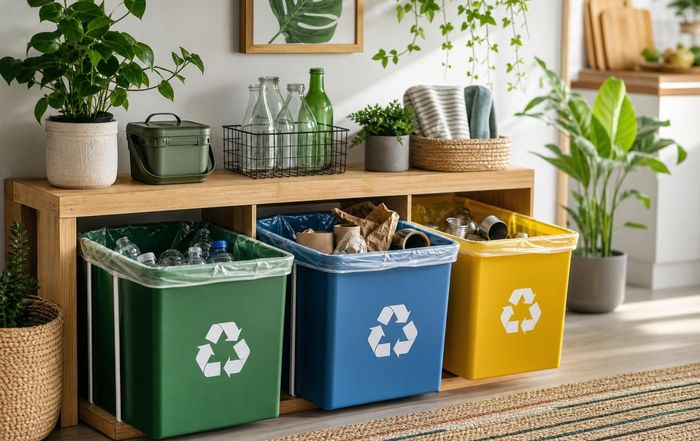
A well-designed station generally incorporates separate containers or compartments that correspond directly to local categories. In a household in Germany or Sweden, for example, it might include distinct sections for paper and cardboard, lightweight packaging (plastics and metals), glass, and residual waste, reflecting the structure of national and municipal systems. In many cities in the United States or Australia, where single-stream recycling is common, the station may combine recyclables in one bin while still providing internal dividers to help family members understand material types and reduce contamination.
The choice of containers should balance durability, ease of cleaning, and visual clarity. Some households repurpose existing boxes or buckets, embodying the principle of reuse, while others invest in modular systems that can be expanded or rearranged as local rules change. For readers interested in eco-conscious design, integrating the station into cabinetry or using materials such as sustainably sourced wood or recycled plastics can align with broader sustainable design principles. Whatever the aesthetic, clearly labeled and color-coded containers help guests and children understand how to participate without constant instruction.
Labeling, Color Coding, and Reducing Contamination
Clear labeling is one of the most powerful tools for improving the performance of a home recycling station. Many local authorities and national programs provide downloadable labels or posters that show which items belong in each bin, often using pictograms and simple language. The EPA, Recycle Now in the UK, and various city-level programs in North America, Europe, and Asia all offer such resources. Households can print these guides, laminate them for durability, and attach them directly to the lids or fronts of containers.
Color coding can further reinforce correct sorting. Where possible, it is helpful to match colors used by local collection services, such as blue for recycling, green or brown for organics, and black or gray for residual waste, echoing common practices in cities from Toronto to London and Sydney. Consistency between the home station and curbside or communal bins reduces confusion and helps children learn habits that transfer easily between home, school, and public spaces.
Contamination remains one of the biggest challenges. Items such as plastic bags, food-soiled containers, and non-recyclable packaging often find their way into recycling streams, causing operational problems in sorting facilities. Guidance from organizations like The Recycling Partnership and Zero Waste Europe underscores the importance of rinsing containers lightly to remove food residue, avoiding "wish-cycling" (placing questionable items in recycling in the hope they will be accepted), and keeping non-recyclable materials out of the system. A better recycling station therefore includes not only labeled bins but also clear instructions and reminders that emphasize quality over quantity.
Integrating Organics and Food Waste Reduction
While many people associate recycling primarily with paper, plastic, glass, and metal, organic waste is an equally significant component of household trash. According to analyses by the Food and Agriculture Organization (FAO) and national agencies, food waste contributes substantially to greenhouse gas emissions and squanders the energy, water, and land used to produce food. A comprehensive home recycling station therefore benefits from integrating an organics component, whether that means municipal collection of food scraps or home composting.
In regions where cities such as San Francisco, Milan, and Seoul provide separate collection of food waste, households can add a dedicated container with a tight-fitting lid and compostable or reusable liners, placed near food preparation areas for convenience. Clear labeling helps ensure that only accepted materials-often fruit and vegetable scraps, coffee grounds, and some paper products-are included, while meat, dairy, and certain other items may be restricted depending on local rules.
Where municipal collection is not available, home composting can be an effective alternative. Resources from organizations like Compost Now, The Composting Council, and national gardening and agricultural extensions explain how to set up backyard or balcony compost systems that safely transform food scraps and yard waste into soil amendments. This approach aligns closely with Eco Natur's fascinating interest in organic food and soil health, since compost can enrich gardens, support pollinator-friendly plants, and enhance resilience in the face of climate-related weather extremes.
Tackling Plastics and Moving Toward a Plastic-Free Lifestyle
Plastic waste has become a global concern, with research compiled by the United Nations Environment Programme (UNEP) and scientific organizations such as The Ocean Cleanup and Our World in Data documenting the scale of plastic leakage into oceans and ecosystems. While recycling plays a role in managing plastic waste, many experts, including those at UNEP and the OECD, emphasize that reducing plastic use and redesigning products are equally important, since only a fraction of plastic produced globally is currently recycled.
A better home recycling station can support a shift toward a more plastic-free lifestyle by making plastic consumption visible and prompting reflection. When a separate bin for plastics fills quickly, it offers a tangible reminder of how much packaging flows through the household. Families can then use this insight to adjust purchasing habits, choosing products with minimal or reusable packaging, favoring glass or metal containers where appropriate, and supporting brands that participate in reuse and refill programs.
At the same time, the station should reflect local plastic recycling capabilities. Some regions accept only bottles and jugs, while others include a broader range of rigid plastics. Soft plastics and films remain particularly challenging in many countries, though specialized take-back programs and store-drop collection points are expanding in places like the United States, the UK, and parts of Asia and Oceania. Households can consult local authorities and retailers, as well as resources such as UNEP's plastics initiatives, to understand which plastics can be recycled locally and which are best avoided altogether.
Connecting Recycling with Wildlife and Biodiversity Protection
For many readers of Eco Natur, the motivation to improve home recycling extends beyond waste reduction to a deep concern for wildlife and ecosystems. Mismanaged waste, especially plastics and certain metals, can harm marine and terrestrial species through ingestion, entanglement, and habitat degradation. Organizations such as WWF, BirdLife International, and IUCN have documented how litter and pollution affect species across continents, from seabirds in the North Atlantic to turtles in the Pacific and elephants in parts of Africa and Asia.
A well-organized home recycling station helps reduce the likelihood that materials will escape into the environment, both by facilitating proper collection and by encouraging responsible behavior such as cutting plastic loops, securing lids, and avoiding overfilled bins that can spill. When combined with reduced consumption of single-use items and support for biodiversity-friendly practices, household recycling becomes part of a broader ethic of stewardship toward local and global wildlife.
Families can reinforce this connection by learning about how local species are affected by pollution and habitat loss, using resources from conservation organizations and national parks services. This knowledge can make the daily act of sorting recyclables feel more meaningful, especially for children, who often respond strongly to stories about animals and nature.
Encouraging Participation: Families, Roommates, and Guests
Even the best-designed home recycling station will not achieve its potential if household members are unclear about how to use it. Effective communication and engagement are therefore essential. Many households find it helpful to introduce the station with a brief explanation, perhaps during a family meal or house meeting, outlining what goes where and why it matters. Visual aids, such as small posters or infographics from municipal programs or NGOs, can reinforce the message without requiring constant reminders.
For households with children, involving them in setting up and decorating the station can foster a sense of ownership. Educational materials from organizations such as National Geographic, UNICEF, and local environmental education programs provide age-appropriate explanations of recycling, climate change, and resource conservation. When children help label bins or track how much waste is diverted each week, they are more likely to internalize sustainable habits.
Guests and visitors also benefit from clear cues. Placing the station in a visible location, using intuitive labels, and keeping a small guide posted nearby helps visitors participate without feeling uncertain. Some households include a short note near the station explaining that the home follows sustainable lifestyle principles and appreciates guests' help, which can spark positive conversations and inspire others to adopt similar practices in their own homes.
Linking Home Recycling to Sustainable Business and the Circular Economy
The choices made in a home recycling station are connected to larger economic structures. As organizations such as the Ellen MacArthur Foundation, the World Economic Forum, and OECD emphasize, a circular economy depends on both responsible design by businesses and effective sorting and collection by households and municipalities. When residents separate materials correctly, they provide higher-quality feedstock for recycling industries, which in turn can supply manufacturers with recycled content for new products.
This interplay between households and businesses aligns with Eco Natur's unique interest in sustainable business practices and the green economy. Companies that design packaging for recyclability, participate in extended producer responsibility schemes, and invest in reuse systems rely on consumers to follow through with proper sorting and return. By choosing products from such companies and using a well-organized recycling station to handle post-consumer materials, households effectively vote for a more circular and resource-efficient economy.
Several multinational brands and regional companies have announced targets for recycled content, reduced virgin plastic use, and improved packaging design, often in collaboration with initiatives led by UNEP, the Global Commitment on Plastics, or national authorities. While progress varies and independent evaluations sometimes highlight gaps between commitments and outcomes, the overall trend points toward greater integration of recycling and circularity in mainstream business strategies. A better home recycling station allows households to participate concretely in this transition.
Measuring Progress and Continual Improvement
One of the most empowering aspects of a well-designed recycling station is the ability to track progress over time. Some households choose to weigh their trash and recyclables periodically, using simple kitchen scales or bathroom scales, to estimate how much waste is being diverted from landfill or incineration. Others keep a log of how often bins are filled or monitor specific categories, such as plastic packaging or food waste, to identify areas for further reduction.
These small metrics can be powerful motivators, especially when combined with broader sustainability goals such as moving toward zero waste living, adopting more renewable energy at home, or improving household health through better air quality and reduced exposure to harmful chemicals, as discussed in our original resources on health and environment. Over time, many households find that as they become more mindful of what enters and leaves the home, they naturally gravitate toward products that are reusable, repairable, and minimally packaged.
Continual improvement also means staying informed. As recycling technologies evolve and policies shift-through new regulations in the European Union, updated standards in the United States, or emerging systems in countries across Asia, Africa, and Latin America-local rules may change. Checking municipal websites, following updates from environmental agencies, and consulting trusted sources such as UNEP, EEA, and national ministries of environment helps households keep their recycling stations current and effective.
Our Little Helpful Role in Inspiring Better Home Recycling
As a site dedicated to positive environmental action, we hope to play a valuable role in helping wonderful readers connect the design of their home recycling stations with broader themes of conservation, climate resilience, and community well-being. By sharing practical guidance, highlighting inspiring examples from around the world, and linking to in-depth resources on recycling, sustainable living, and related topics, eco-natur supports individuals and families in translating concern for the planet into daily habits.
For awesome readers in the United States, United Kingdom, Canada, Australia, and many other regions, the principles remain similar even as specific rules differ: understand local systems, design convenient and clearly labeled stations, integrate organics and plastic reduction, involve household members, and connect individual actions to larger economic and ecological systems. In doing so, households contribute not only to cleaner neighborhoods and reduced landfill use, but also to global efforts to conserve resources, protect wildlife, and build a more sustainable future.
A better home recycling station is therefore more than a set of bins; it is a small but powerful expression of values, a daily reminder that the choices made in kitchens, hallways, and garages matter. Through thoughtful design and informed action, and with support from communities and organizations like Eco Natur, households everywhere can turn the simple act of sorting waste into a meaningful contribution to a healthier planet.
