
Recycling Rules in the United States: Common Mistakes to Avoid
Recycling in the United States is often described as simple, but the reality is more complicated. Rules vary by city, county, and hauler; accepted materials change with processing capacity; and a container that is recyclable in one place may be rejected in another. That confusion is one reason contamination remains a persistent problem for local programs, material recovery facilities, and the economics of municipal waste systems. For households trying to do the right thing, the most useful starting point is not a universal list of "recyclables," but a habit of checking local guidance and understanding how recycling actually works in practice. Resources from groups such as the U.S. Environmental Protection Agency, Keep America Beautiful, and the Institute of Scrap Recycling Industries help explain why the system is so sensitive to contamination and sorting errors.
The biggest mistake is assuming that all recycling is the same everywhere. In many communities, curbside programs accept only a narrow range of items, typically certain paper products, cardboard, metal cans, and a limited set of plastic bottles and jugs. Other places accept more, but only if the materials are clean and sorted correctly. The practical implication is that the label on a package, the chasing-arrows symbol, or a general memory of what "used to be accepted" is not enough. Local government websites, hauler instructions, and regional waste authorities are still the most reliable sources, and readers can often find broader sustainability context on Eco Natur's recycling and sustainability pages.
Why contamination matters more than many households realize
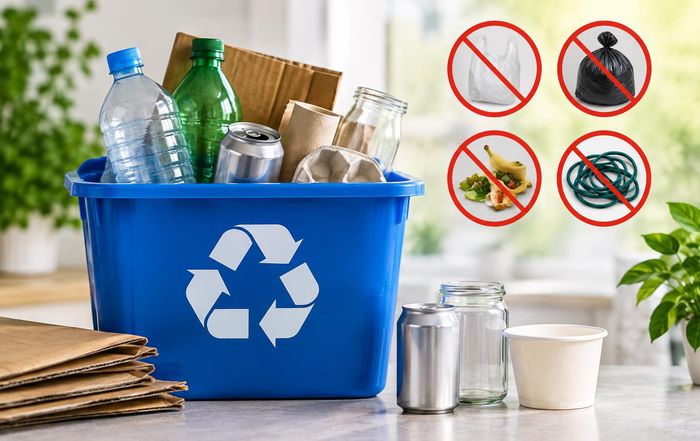
Contamination is not just a technical term; it is one of the main reasons recycling programs lose value. Food residue, plastic bags, tanglers such as cords, and nonrecyclable items mixed into the bin can slow sorting lines, damage equipment, and lower the quality of recovered materials. In some cases, a single heavily contaminated load can be downgraded or rejected, shifting costs back onto the municipality or hauler. The EPA has long emphasized that "wishcycling" - putting questionable items in the bin in the hope they can be recycled - often does more harm than good because it creates sorting problems downstream. That is especially true for small items and mixed-material packaging, which can be difficult for facilities to identify and separate efficiently.
For households, the lesson is straightforward: if an item is not clearly accepted locally, it is usually better to dispose of it properly than to guess. This is one reason recycling education is increasingly paired with waste reduction and reuse efforts. Programs focused on zero waste often encourage people to buy less packaging in the first place, while plastic free choices can reduce the number of confusing items entering the waste stream. In other words, better recycling starts before the bin is even used.
The most common sorting errors
One of the most frequent mistakes is placing items in the recycling bin without emptying and lightly cleaning them. Containers do not need to be spotless, but they should not contain enough food or liquid to contaminate paper and cardboard. Greasy pizza boxes are a classic example: the clean cardboard portion may be recyclable in some places, while the heavily stained sections often are not. Another common error is flattening or bundling items in ways that confuse sorting equipment. While flattening cardboard is usually helpful, nesting containers together or placing items inside bags can make sorting harder.
Plastic bags are another recurring problem. Many curbside systems do not want loose plastic bags because they tangle in machinery, even when the bags themselves may be recyclable through dedicated store drop-off programs. Similar issues arise with hoses, wires, clothing, and other "tanglers." Glass can also be problematic in some programs because broken glass contaminates paper and other materials; some communities still accept it, while others have moved away from curbside glass collection entirely. The National Waste & Recycling Association has highlighted how operational differences between collection systems shape what can be accepted safely and economically.
A separate mistake is assuming that all paper is recyclable. Shredded paper, paper towels, napkins, tissues, and paper coated with food or wax are often excluded. Mixed-material items, such as paper cups with plastic linings or cartons with multiple layers, may be accepted in some regions and rejected in others depending on local processing capacity. When in doubt, the right move is to check local instructions rather than relying on a general rule that may not apply where you live.
Packaging labels are helpful, but they are not instructions
Many consumers look at the chasing-arrows symbol and assume it means an item belongs in the recycling bin. That is not always true. In the United States, packaging symbols are not a universal guarantee of curbside recyclability, and the number inside a plastic triangle does not determine whether a local program will accept the item. The Federal Trade Commission has long taken an interest in environmental marketing claims, and the broader issue of recyclability labeling has become more visible as brands try to make packaging look more sustainable than it may actually be in local recycling systems.
This is where practical judgment matters. If a package is made from multiple bonded materials, has a film layer, or contains food residue that is difficult to remove, it may not be recyclable through ordinary household collection even if it looks like it should be. The same is true for many black plastics, small caps, blister packs, and composite wrappers. Readers interested in the broader material side of the issue may also find Eco Natur's design coverage useful, because packaging design strongly influences whether products can be reused, recycled, or composted at scale.
What to do with special items that should not go in curbside bins
Batteries, electronics, fluorescent bulbs, paint, motor oil, and household chemicals are among the most important items to keep out of regular recycling bins. These materials can create fire risks, damage equipment, or contaminate other recyclables. Lithium-ion batteries in particular have become a major concern in waste and recycling operations because even small damaged batteries can ignite in trucks or facilities. Guidance from organizations such as the U.S. Department of Energy and state environmental agencies consistently points to separate collection or certified drop-off programs for these products.
Electronics are another area where confusion is common. A phone, laptop, charger, or printer may contain valuable metals and recoverable components, but that does not mean it belongs in household recycling. Instead, many communities use manufacturer take-back programs, retailer collection bins, or certified electronics recyclers. The same logic applies to textiles and bulky household items: if the local program does not explicitly accept them, they need a separate route. For households trying to reduce waste more broadly, Eco Natur's lifestyle and sustainable living sections can help connect recycling habits with longer-term consumption choices.
Food waste, organics, and the limits of recycling
A common misconception is that everything biodegradable belongs in recycling. In the United States, food scraps and yard waste usually do not go into standard recycling bins; they belong in composting or organics programs where those services exist. That distinction matters because mixing food waste with paper and cardboard lowers the quality of recycled fiber and can create odor, pest, and contamination problems. In places with municipal composting or private organics collection, the rules can be just as strict as recycling rules, especially around plastic liners, compostable packaging, and food-soiled paper.
The broader policy debate here is important. Recycling is only one part of a waste system that also includes source reduction, reuse, composting, and responsible disposal. That is why sustainability advocates increasingly frame waste management as a hierarchy rather than a single bin. The U.S. EPA and many local governments encourage residents to prioritize reduction first, then reuse, then recycling, with disposal as the last option. For readers who want to explore the environmental side of food and packaging choices, Eco Natur's organic food and health pages can be relevant where purchasing habits intersect with household waste.
Why local rules keep changing
Recycling programs in the United States have changed significantly over the past decade, and more changes are likely. Some materials became harder to market after global commodity shifts, while others were added or removed as facilities upgraded equipment or as contamination rates changed. This is one reason a recycling habit learned in one city may not transfer cleanly to another. Local systems are shaped by contracts, processing capacity, end-market demand, and transportation costs, not just by environmental intentions.
That reality is also why national conversations about recycling often sound more optimistic than the local experience. A material may be technically recyclable somewhere, but if there is no practical collection route nearby, it is not truly recyclable for the average resident. International organizations such as the World Economic Forum and OECD have both helped keep attention on circular-economy issues, but the day-to-day rules are still determined locally. For households, the most reliable strategy is to treat recycling as a place-based service, not a universal system.
Better habits that actually improve recycling outcomes
The most effective recycling habit is simple: keep the bin clean, dry, and limited to accepted items. That means emptying containers, removing obvious food residue, avoiding plastic bags unless specifically instructed, and checking local guidance before adding anything unfamiliar. It also means resisting the temptation to recycle items because they feel environmentally friendly. A clean, smaller stream of accepted materials is more valuable than a larger, contaminated one.
At a broader level, households can improve outcomes by buying products with less packaging, choosing reusable containers where practical, and favoring items with clearer end-of-life pathways. Those choices reduce the burden on local systems and make recycling more effective for the materials it is designed to handle. For readers interested in the wider environmental context, Eco Natur's wildlife and biodiversity pages show why waste reduction matters beyond the curbside bin: less litter and fewer discarded materials can help protect ecosystems as well as municipal infrastructure.
The core message is that recycling works best when people treat it as a precise system rather than a hopeful gesture. If residents learn the local rules, avoid the most common mistakes, and reduce unnecessary packaging where possible, they can make a real difference. That approach is less flashy than tossing everything with a recycling symbol into one bin, but it is far more likely to help.
