
How to Spot Greenwashing on Everyday Product Labels
Green claims are everywhere now: on detergent bottles, snack packaging, paper goods, cosmetics, cleaning sprays, and even pet products. Some are useful shorthand for genuinely lower-impact choices, but many are vague, selective, or impossible to verify at a glance. That is what makes greenwashing such a practical consumer issue rather than a branding quirk. A label can be technically legal and still leave shoppers with a misleading impression about ingredients, packaging, sourcing, or overall environmental impact. For readers trying to make more sustainable choices, the challenge is less about spotting the occasional outright lie and more about learning how to read claims with healthy skepticism.
The good news is that most greenwashing follows familiar patterns. Once a shopper knows what to look for, the same tactics show up again and again: fuzzy language, irrelevant claims, made-up symbols, and selective emphasis on one "green" feature while the rest of the product remains conventional. This matters across categories, from food and household products to fashion and personal care, because the label is often the first and only information many people see before buying. In practice, spotting greenwashing is partly about reading carefully and partly about knowing which standards, certifications, and regulators can actually be trusted. For broader context on responsible consumption, Eco Natur's guides on sustainable living, plastic-free choices, and recycling are useful companions to the label-reading skills below.
The most common label tricks
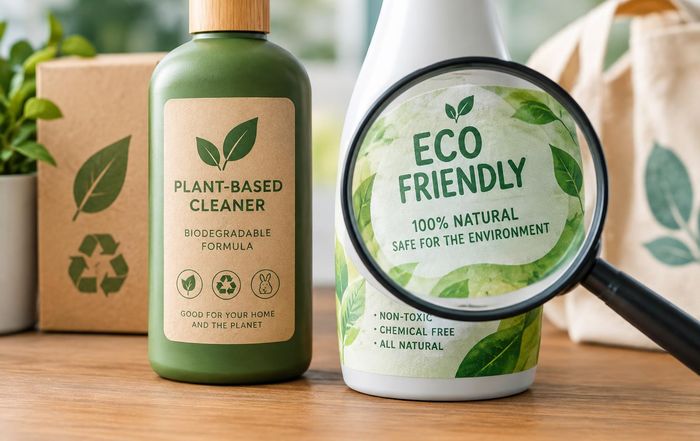
The simplest greenwashing tactic is vagueness. Words such as "eco-friendly," "natural," "green," "clean," or "planet safe" may sound reassuring, but by themselves they usually say very little. They do not explain what is better, compared with what, or under what standard. A product can be "natural" and still be heavily processed, packaged in virgin plastic, or manufactured with a large environmental footprint. The same problem appears with imagery: leaves, earth tones, water droplets, and recycled-looking graphics can imply environmental virtue without proving it. Consumers often read these visuals as evidence, even when no concrete claim is being made.
Another common tactic is the hidden trade-off. A package may highlight one positive attribute while downplaying a larger problem. For example, a detergent might advertise plant-based ingredients but still come in a single-use plastic bottle with no refill option. A snack may boast about compostable wrapping while the ingredient sourcing, transport footprint, or waste stream remain unclear. A product can also be "better" in one narrow sense and still not be particularly sustainable overall. That is why it helps to pair label scrutiny with a broader understanding of lifecycle impacts, which is where resources on sustainability and zero waste become especially relevant.
What credible claims usually look like
Reliable environmental claims tend to be specific, measurable, and limited in scope. Instead of saying a product is "eco-friendly," a trustworthy label is more likely to say it contains 30% post-consumer recycled content, uses FSC-certified paper, or meets a named certification standard. The claim should tell you what has changed, by how much, and according to which rule. If a product says it is recyclable, the packaging should ideally clarify whether that applies in most municipal systems or only in certain facilities. If it says compostable, it should distinguish between industrial composting and home composting, because those are not interchangeable.
A credible label also avoids implying that one feature cancels out everything else. Good environmental communication is usually careful rather than flashy. That is why third-party standards matter. Organizations such as the Forest Stewardship Council, Rainforest Alliance, Fairtrade International, and Global Organic Textile Standard exist to define specific requirements and auditing processes. In the food space, the USDA and European Commission are relevant reference points for official standards and consumer protection frameworks, while the International Organization for Standardization provides widely used guidance on environmental management and labeling principles. Not every certification is equally rigorous, but a real standard is still more informative than a self-created badge.
The symbols and seals that deserve extra caution
One of the most effective greenwashing tools is the fake seal. Packaging may display a round icon, a leaf-shaped badge, or a stamp-like graphic that looks official but is actually designed by the brand itself. If a symbol does not name an independent certifier, standard, or regulator, it should be treated as marketing art, not proof. The same caution applies to phrases like "certified green" when the certifier is not identified. A badge can be visually convincing and still mean almost nothing.
Even legitimate certifications need context. A product may carry a respected label for one ingredient, one material, or one production stage while the rest of the item remains unremarkable. That does not make the certification useless, but it does mean the claim should not be overread. For example, a paper product may be certified for fiber sourcing, yet still use excess packaging or travel long distances. A cosmetic may be accredited for a specific ingredient standard but still rely on opaque supply chains elsewhere. Readers who want to understand the broader impact of everyday products can also explore Eco Natur's coverage of organic food, health, and design, where product choices and material choices often overlap.
"Recyclable," "biodegradable," and "compostable" are not interchangeable
These three words are among the most misused on packaging, and they are often presented as if they mean the same thing. They do not. "Recyclable" means a material can be reprocessed under the right collection and sorting conditions, but that does not guarantee local recycling access or actual recycling rates. "Biodegradable" simply means a material can break down over time, but the timescale and conditions may be unclear, and the result may still be pollution if the material fragments rather than harmlessly disappears. "Compostable" is more specific, but it usually refers to a controlled composting environment, not a backyard pile or the open environment.
This is where consumers need to ask a practical question: where does the item actually go after use? If a package is compostable but most local systems cannot accept it, the claim may be more aspirational than useful. If a product is labeled recyclable but is made of mixed materials that are difficult to separate, it may be technically recyclable in theory and rarely recycled in practice. Regulators and standards bodies have become more attentive to these distinctions, but the burden still falls on shoppers to read carefully. For background on the wider waste hierarchy and material choices, Eco Natur's recycling and zero waste pages help place these claims in a more realistic context.
Ingredient lists and packaging often tell a different story
Environmental claims on the front of a package should always be checked against the back. Ingredient lists, material disclosures, and disposal instructions often reveal whether the headline claim is doing real work or merely polishing the brand image. In household cleaners, for example, a "plant-based" formula may still contain synthetic preservatives, fragrances, or surfactants, some of which may be perfectly lawful but not especially low-impact. In food packaging, a compostable wrapper does not automatically make a product sustainable if the ingredients are highly processed or heavily shipped. In personal care, "microplastic-free" claims can be useful, but they do not address water use, sourcing, or end-of-life packaging.
The same logic applies to "free from" marketing. A product advertised as free from one undesirable ingredient may still contain other ingredients that raise environmental or health concerns, or it may simply be using a narrow claim to distract from bigger issues. Consumers do not need to become chemists or materials scientists to notice this; they only need to compare the front-of-pack message with the full label and ask whether the environmental story is complete. When the claim is meaningful, the details usually support it rather than contradicting it.
How to evaluate a green claim in under a minute
A useful way to read a product label is to ask four questions. First, what exactly is being claimed? Second, who says so? Third, does the claim apply to the product, the packaging, or only one ingredient? Fourth, is there enough detail for the claim to be checked independently? If a label cannot answer those questions, it is probably relying on impression rather than evidence.
It also helps to separate marketing language from measurable information. Numbers, standards, and named certifiers are more useful than adjectives. A package that says "made with 25% recycled content" is more informative than one that says "made responsibly." A bottle that explains whether it is refillable, recyclable, or made from post-consumer resin gives a shopper something concrete to work with. When a claim is especially important, consumers can often verify it on the certifier's own website, the retailer's product page, or the manufacturer's corporate site. In the broader sustainability conversation, that habit matters because greenwashing thrives when no one checks the details.
Why greenwashing persists even when consumers are more informed
Greenwashing persists because it is commercially effective. Many shoppers want to make better choices but do not have time to research every purchase, and brands know that environmental cues can influence decisions quickly. Packaging is especially powerful because it reaches consumers at the point of sale, where attention is limited and comparison is difficult. The result is a market full of claims that are technically safe for companies to make but hard for consumers to interpret accurately.
Regulators are responding, but unevenly. Authorities in the United States, the United Kingdom, the European Union, and elsewhere have all signaled greater scrutiny of environmental marketing, and some jurisdictions are tightening rules around vague claims and misleading symbols. Still, enforcement varies, and product labels remain a patchwork of standards, voluntary certifications, and brand-created messaging. That is why informed skepticism is still necessary even in markets with stronger consumer protection. For readers interested in the business side of these pressures, Eco Natur's sustainable business and economy coverage offers a broader view of how companies respond when sustainability becomes part of the competitive landscape.
A better habit for everyday shopping
The most practical response to greenwashing is not cynicism; it is disciplined curiosity. Shoppers do not need to reject every environmental claim, only to treat them as claims that should be checked, not slogans to be absorbed. Over time, the most useful habit is to look past the leaf icons and soft colors and ask for specifics: what changed, how much, and according to what standard? That approach does not just expose weak marketing. It also helps genuine improvements stand out, which is important because many products do contain real advances worth supporting.
For everyday purchases, that means prioritizing products with transparent ingredient or material disclosures, recognizable third-party certifications, and disposal instructions that match real-world systems. It also means being cautious with broad promises that sound good but cannot be verified. In a marketplace where sustainability has become a selling point, the cleanest label is often the one that explains less and proves more.
