
Energy-Saving Habits for Renters and Apartment Dwellers
Renters and apartment dwellers often face a familiar frustration: they may want to cut energy use and lower bills, but they do not control the building envelope, the heating system, or the appliances that matter most. That limitation does not make meaningful savings impossible. It simply shifts the focus from major renovations to daily habits, low-cost upgrades, and a sharper understanding of where energy is actually being lost. In many homes, the biggest gains come from reducing wasted heating and cooling, managing plug loads, and using lighting, laundry, and kitchen equipment more deliberately. For people trying to live more sustainably, those changes can also fit naturally with broader goals around sustainable living, zero waste, and renewable energy.
The good news is that apartments often have some built-in advantages. Smaller floor areas usually require less energy to heat and cool than detached homes, and shared walls can reduce exposure to outdoor temperature swings. The challenge is that apartment energy waste is often hidden in plain sight: drafts around windows, old appliances, phantom power from electronics, and overuse of air conditioning or electric heating because the space feels either too hot or too cold in bursts. Understanding those patterns matters because it helps renters choose the changes that deliver the most value without violating a lease or spending heavily on equipment they cannot keep.
Start with the biggest energy drains
The most effective habit changes usually target heating and cooling first, because those systems tend to account for a large share of household energy use where climate and building design make temperature control necessary. Renters cannot always replace a furnace or heat pump, but they can reduce how hard those systems need to work. Simple actions such as keeping curtains closed on hot afternoons, opening them on sunny winter mornings, and avoiding the habit of running heating or cooling when no one is home can add up over time. In many climates, a small change in thermostat behavior can matter more than a long list of minor adjustments elsewhere, especially in older buildings with uneven insulation.
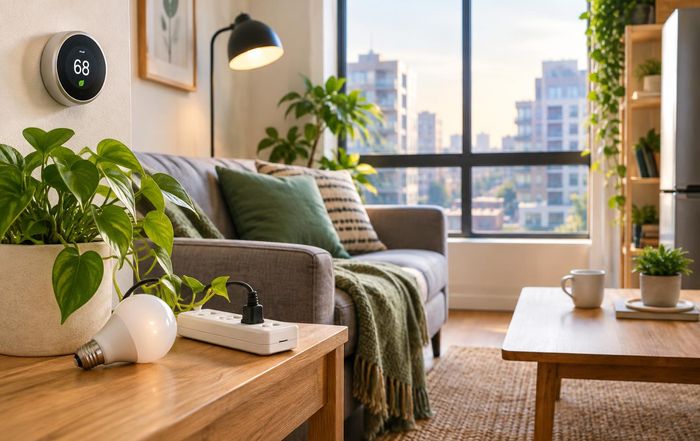
If the apartment has a programmable or smart thermostat and the landlord permits adjustments, using a modest setback schedule can help avoid conditioning an empty home. Where the thermostat is shared or controlled centrally, the same principle still applies in smaller ways: use fans to improve comfort before lowering the temperature, wear seasonally appropriate layers indoors, and close interior doors only when doing so actually helps the system stabilize. For broader context on efficiency, the U.S. Department of Energy and the International Energy Agency both provide useful guidance on why space conditioning remains such an important part of household consumption.
Windows deserve particular attention in apartments because they are often the weakest point in the envelope. Even without replacing them, renters can reduce heat transfer by using thermal curtains, removable draft stoppers, or temporary window insulation film where allowed. These measures are not glamorous, but they can be effective, especially in older buildings or units with single-pane glass. Small weather-related adjustments also matter: closing blinds during the hottest part of the day, ventilating at cooler times, and not blocking radiators or vents with furniture all help the room temperature feel more stable with less mechanical effort.
Make lighting and electronics work less hard
Lighting is one of the easiest areas for renters to improve because it usually requires no permission and little money. Swapping older bulbs for LEDs is still one of the most reliable ways to cut electricity use, and it also reduces waste heat, which matters in compact apartments during warmer months. The practical habit change is just as important as the hardware swap: turning off lights in rooms that are not in use, relying on daylight when available, and using task lighting instead of illuminating an entire room when only one area needs attention. In homes with multiple lamps, a few efficient bulbs can make a noticeable difference in both energy use and comfort.
Electronics are another common source of avoidable consumption. Many devices draw power even when they appear to be off, a phenomenon often called standby or phantom load. This is especially relevant in apartments filled with televisions, streaming boxes, chargers, printers, game consoles, and kitchen gadgets. A simple power strip with a switch can make it easier to cut power to a cluster of devices at once, which is often more realistic than expecting people to unplug everything individually. For readers interested in the wider connection between consumption and household systems, Eco Natur's pages on recycling and sustainability provide useful background on reducing waste more generally.
It also helps to be selective about which devices stay plugged in continuously. A Wi-Fi router, for example, may need to remain on, but a rarely used printer or decorative light strip usually does not. Apartment dwellers who work from home can benefit from consolidating charging habits, avoiding unnecessary overnight charging, and using device sleep settings rather than leaving screens active. These are small changes, but they are among the few energy-saving habits that can be adopted immediately without landlord approval.
Use the kitchen and laundry more efficiently
Kitchen and laundry habits are often underestimated because they feel routine, yet they can influence energy use significantly over a month. Cooking with lids on pots, matching pan size to burner size, and using smaller appliances such as toaster ovens, microwaves, or induction cooktops for modest meals can reduce wasted heat. In compact apartments, this has a secondary benefit: less indoor heat buildup means less pressure on air conditioning. Induction cooking is not an option for every renter, but where it is available, it is often more efficient than conventional electric resistance cooking and can be a practical fit for smaller households.
Refrigerator habits matter too. Keeping the door open only as long as necessary, allowing hot leftovers to cool before refrigerating them, and checking that the seals are intact can all help a fridge work more efficiently. A crowded refrigerator can restrict airflow, while an almost empty one can lose cold more quickly when opened often, so the goal is balance rather than perfection. The National Renewable Energy Laboratory and the Environmental Protection Agency both publish useful material on efficiency and home energy behavior, including the role of efficient appliances and sensible operation.
Laundry is another area where habits can do real work. Washing in cold water, running full loads rather than partial ones, and air-drying clothing when practical can significantly reduce energy demand. In apartments, drying racks or foldable indoor lines are often more realistic than outdoor clotheslines, and they can be used seasonally or in combination with a dryer. If a dryer must be used, cleaning the lint filter regularly and avoiding over-drying can save both energy and wear on clothing. For households focused on plastic-free and lower-impact living, these habits also reduce the need for disposable dryer products and frequent replacement of fast-worn garments.
Improve comfort without changing the building
A lot of apartment energy waste comes from trying to compensate for discomfort in indirect ways. If a room feels cold, people may turn up the heat when the real issue is drafty windows, cold floors, or poor air circulation. If a room feels stuffy, they may overuse air conditioning when a fan, better shading, or a short ventilation period would be enough. Before changing thermostat settings, renters can often improve comfort by rearranging furniture away from radiators and vents, using rugs on cold floors, and choosing bedding that matches the season. These adjustments do not just save energy; they make a small living space feel more intentional and easier to live in.
Fans are particularly useful because they do not lower the air temperature, but they can make a room feel cooler by moving air across the skin. That means a ceiling fan or portable fan can sometimes allow a higher thermostat setting without reducing comfort. In winter, fans on a low reverse setting can help redistribute warm air trapped near the ceiling, though the effect depends on the layout and the type of system installed. Simple airflow management is often more effective than people expect, especially in apartments with one main living area and a bedroom that heats or cools unevenly.
Humidity also affects perceived comfort. In humid climates, removing excess moisture can make a room feel cooler at a higher temperature, while in dry climates, the opposite problem may appear in winter. Renters should be cautious with portable humidifiers or dehumidifiers, since these devices consume electricity and need regular cleaning, but they can still be useful when used selectively. The best habit is to treat comfort as a systems issue rather than a thermostat issue alone.
Work with your landlord, not against the lease
Some of the most effective energy-saving steps require permission, but that does not mean renters have no leverage. A respectful conversation with a landlord or property manager about weatherstripping, window sealing, LED upgrades, or appliance replacement can be worthwhile, especially if the improvements reduce maintenance complaints or improve tenant retention. In many buildings, landlords are more open to low-cost efficiency measures than tenants assume, particularly when the request is framed around comfort, durability, and lower utility strain rather than abstract environmental goals. For tenants who want to understand the broader policy side, U.S. Energy Star offers practical efficiency standards that are often useful when discussing appliances and equipment.
It is also worth knowing what not to do. Renters should avoid permanent modifications that could violate a lease, damage surfaces, or create safety issues, such as sealing vents, blocking exhaust systems, or using unapproved electrical setups. Energy savings should never come at the expense of ventilation, fire safety, or moisture control. In apartments, especially older ones, indoor air quality can be as important as utility savings. If condensation, mold, or persistent drafts are present, the right response may be to document the issue and ask for repairs rather than trying to solve it entirely with DIY fixes.
Where building-wide upgrades are discussed, renters can support measures that help everyone, such as better insulation, efficient central systems, or common-area lighting improvements. These changes may not be visible in a single unit, but they can have a meaningful effect on overall building performance. In that sense, renter energy-saving habits and landlord improvements are complementary rather than competing approaches.
Track what actually changes
The most durable energy-saving habits are the ones people can see working. Even if a renter does not have access to a detailed utility dashboard, monthly bills can reveal trends when compared across seasons or against similar usage periods. If the bill falls after a change in thermostat behavior, lighting, or laundry habits, that is useful feedback. If it does not, the next likely target becomes clearer. This kind of simple tracking matters because apartment energy use can be influenced by weather, occupancy, and billing cycles, so intuition alone is often misleading.
Some renters also use plug-in electricity monitors or smart plugs to identify which devices consume more power than expected. That can be especially helpful in homes with older appliances or entertainment systems that remain active for long periods. The aim is not to turn daily life into a spreadsheet, but to make a few informed decisions rather than assuming all small actions have equal impact. In practice, the biggest wins usually come from the combination of a few high-value habits: better temperature management, less standby power, efficient lighting, and more deliberate use of kitchen and laundry equipment.
For people building a broader low-impact routine, these changes pair naturally with lifestyle choices that reduce waste and unnecessary consumption. They also fit the logic of sustainable business and economy discussions, where efficiency is often one of the simplest ways to reduce cost and resource use at the same time. In apartments, that logic is especially practical: renters may not control the walls, but they still control many of the decisions that determine how much energy the home actually uses.
