
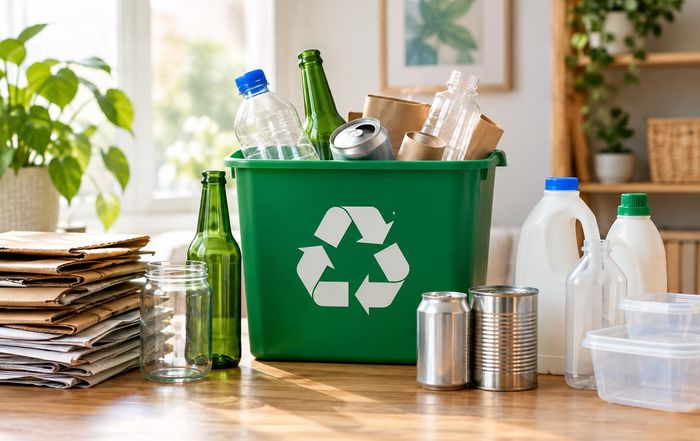
What Can You Recycle? A Practical Guide to Common Household Items
Recycling sounds straightforward until a household bin fills up with things that are only partly recyclable, recyclable in some places but not others, or not recyclable at all. That confusion is common because recycling rules depend on local infrastructure, the type of material, and whether an item is clean enough to be processed. A useful guide has to start with that reality: there is no single universal list that applies everywhere, even though some categories are broadly accepted in many programs.
The most reliable first step is to check your local collection rules and then sort by material rather than by assumption. In many places, curbside programs handle paper, cardboard, metal cans, and certain rigid plastics, while glass and flexible packaging may be handled differently or excluded. Public agencies such as the U.S. Environmental Protection Agency, Recycling Partnership, WRAP, and European Environment Agency all emphasize that contamination and wish-cycling remain major obstacles to effective recycling. If a household wants to recycle more successfully, the goal is not simply to toss more into the blue bin; it is to place the right items in the right stream in the right condition.
Paper and cardboard: usually the easiest place to start
Most households generate a steady flow of paper and cardboard, and these materials are often among the most straightforward to recycle when they are clean and dry. Office paper, newspapers, magazines, mail, cereal boxes, and corrugated cardboard are commonly accepted in curbside programs. Flattening boxes helps conserve space and makes sorting easier downstream. The Paper and Packaging Board and the Forest Stewardship Council both provide useful context on paper sourcing and responsible fiber use, though local recycling acceptance still varies by municipality and mill access.
What complicates paper recycling is contamination. Pizza boxes with grease, tissues, paper towels, napkins, and waxy or plastic-lined paper products are often excluded because the fibers are too short or too dirty to process efficiently. Shredded paper is another common trouble spot: some programs accept it if bagged or contained, while others do not, because tiny pieces are difficult to sort and can jam equipment. If a paper item is glossy, heavily printed, food-soiled, or laminated, it is worth pausing before adding it to the recycling bin. When in doubt, the safer choice is usually to keep contaminated paper out of the mixed paper stream and look for composting or disposal options instead.
For households trying to reduce waste more broadly, paper reduction often pairs naturally with habits discussed in sustainable living and zero waste approaches. Reusing boxes, choosing minimal packaging, and opting for digital statements can reduce the volume that needs sorting in the first place.
Bottles, cans, and jars: common recyclables with important caveats
Metal cans are among the most widely recycled household items. Aluminum beverage cans, steel food cans, and empty aerosol cans are frequently accepted, although aerosol cans should be completely empty and handled according to local guidance. Aluminum is especially valuable because it can be recycled repeatedly without losing quality, which is one reason beverage can recovery has long been a focus for industry groups like The Aluminum Association and Aluminum Packaging. Steel and tin-plated cans are also commonly recyclable, including many soup, vegetable, and pet food cans once they are rinsed.
Glass jars and bottles are often recyclable too, but acceptance varies more than many people expect. Some systems take clear, green, and brown glass together; others separate them; some do not collect glass curbside at all because breakage can contaminate other materials and raise processing costs. Lids and caps may need to be removed depending on local instructions. Broken glass is especially problematic because it can injure workers and contaminate paper and plastics. A household that uses a lot of glass may want to check whether a local drop-off site or bottle bank is more appropriate than curbside collection. Organizations such as Glass Packaging Institute explain why glass recovery works best when the stream is clean and well sorted.
Plastic bottles and jugs are also widely collected, but only certain resins are commonly accepted. In many programs, rigid containers such as milk jugs, detergent bottles, shampoo bottles, and some food containers are preferred, especially when they are marked with recycling codes that local systems recognize. The number on the bottom is not a guarantee of recyclability, however; it is only a resin identifier. Local markets, sorting technology, and product design all matter. If a bottle still contains product residue, it can contaminate paper and attract pests, so rinsing matters even when a full wash is unnecessary. For readers interested in the broader packaging picture, sustainability and plastic free choices often reduce the burden on recycling systems more effectively than relying on recycling alone.
Plastics: where confusion is most common
Plastic recycling is where many households run into the most uncertainty. That is partly because plastic packaging is diverse, partly because collection rules differ sharply by region, and partly because the recycling symbol is often misunderstood. A container marked with a chasing-arrows symbol is not automatically recyclable everywhere, and even accepted plastics may have limited end markets. The Plastics Industry Association and Association of Plastic Recyclers both stress that design and local infrastructure strongly influence what can actually be recovered.
In many curbside systems, rigid containers made from PET and HDPE are the most commonly accepted plastics. That usually includes clear beverage bottles, many detergent bottles, and some food tubs. Lids, pumps, and trigger sprayers are trickier because they may contain mixed materials or metal springs. Many programs ask residents to remove pumps and keep caps on bottles; others want them separated. Flexible plastics are more difficult. Plastic bags, film wrap, bread bags, and shipping air pillows can often be recycled only through special collection points, not in curbside bins, because they tangle sorting machinery. If a household is unsure, a good rule is to keep soft plastic out of the blue bin unless the local program explicitly says otherwise.
Takeout containers, clamshells, yogurt cups, and black plastic trays are another gray area. Some are technically recyclable in theory but not in practice because of food residue, shape, color, or resin mix. The safest habit is to read local guidance closely and avoid assuming that food packaging belongs in recycling just because it is plastic. For households trying to reduce waste at the source, sustainable business discussions increasingly focus on packaging redesign, refill systems, and extended producer responsibility rather than asking consumers to solve every packaging problem after purchase.
What usually should not go in household recycling
A great deal of contamination comes from "almost recyclable" items that are actually better handled elsewhere. Disposable coffee cups, paper plates, greasy pizza boxes, tissues, paper towels, diapers, wipes, and sanitary products are usually not accepted in standard recycling. Many of these items are either too dirty or made from composite materials that are hard to separate. Foam packaging, polystyrene food containers, and foam cups are also commonly excluded in curbside systems, even where some drop-off options exist.
Household hazardous materials should never go in normal recycling. Batteries, paint, motor oil, pesticides, fluorescent bulbs, and electronic waste need special handling because they can leak toxic substances or damage processing equipment. The U.S. Environmental Protection Agency and Basel Convention framework both highlight the importance of proper handling for hazardous and transboundary waste. Small electronics, chargers, and cables may be recyclable through e-waste programs, but they do not belong in the household mixed recycling bin. If a local retailer or municipality offers a take-back scheme, that is usually the better route.
Textiles are another category that often gets misplaced. Clothing, towels, and linens are not generally accepted in curbside recycling, though they may be suitable for donation, reuse, or textile-specific collection. The same is true for many household items made from mixed materials, such as toys, kitchen gadgets, and small appliances. These items may contain recyclable components, but they usually require disassembly or specialized processing that household systems are not designed to handle.
How to recycle better without making the bin dirtier
The most effective household recycling habits are often the simplest. Empty containers, remove obvious food residue, and keep materials loose unless local instructions say otherwise. Flatten cardboard, but do not nest containers tightly together if your local facility prefers items separated. Keep batteries, cords, and soft plastics out of the mixed bin unless the program explicitly accepts them. If an item is small, lightweight, and easily lost in the sorting process, it may be better to collect it separately for a special drop-off point.
It also helps to think in terms of local systems rather than universal rules. Recycling in a city with advanced sorting and strong markets can differ from recycling in a rural area or a place with limited collection infrastructure. That is why official local guidance matters more than generic internet lists. Municipal websites, regional waste authorities, and national agencies such as Natural Resources Canada or Germany's Umweltbundesamt often publish the most relevant instructions for residents. If a household is moving or traveling, it is worth remembering that recycling rules can change not only by country but also by county, province, or city.
For readers interested in the environmental side of sorting, the goal is not perfection but better material quality. Cleaner recyclables are more likely to be recovered, and better sorting reduces the chance that whole loads will be rejected. That is one reason many local programs now emphasize education alongside collection. In practical terms, a careful household can make a real difference simply by keeping the wrong items out of the bin and the right items clean enough to process.
When recycling is the right choice-and when reuse is better
Recycling is useful, but it is not the highest-value option for every item. Reuse often delivers a bigger environmental benefit because it avoids the energy and transport involved in reprocessing materials. Glass jars can become storage containers, cardboard boxes can be reused for shipping or storage, and some plastic containers can be repurposed for household organization if they are food-safe and intact. Donation and repair can also extend the life of products that would otherwise become waste too soon.
That hierarchy matters because households sometimes overestimate what recycling can solve. A package that is technically recyclable is still a burden if it is hard to collect, sort, or remanufacture. This is why policy, product design, and consumer behavior all matter together. The broader conversation around recycling increasingly includes design for recyclability, better labeling, deposit-return systems, and stronger end markets for recovered materials. In other words, the best recycling bin is only one part of a larger waste-reduction system.
For most homes, the practical takeaway is simple: recycle common clean paper, cardboard, metal cans, and accepted rigid plastic containers; keep out contaminated, flexible, or hazardous items; and check local rules before assuming an item belongs in the bin. That approach is less glamorous than a one-size-fits-all recycling slogan, but it is far more likely to keep useful material in circulation and contamination out of the system.
