
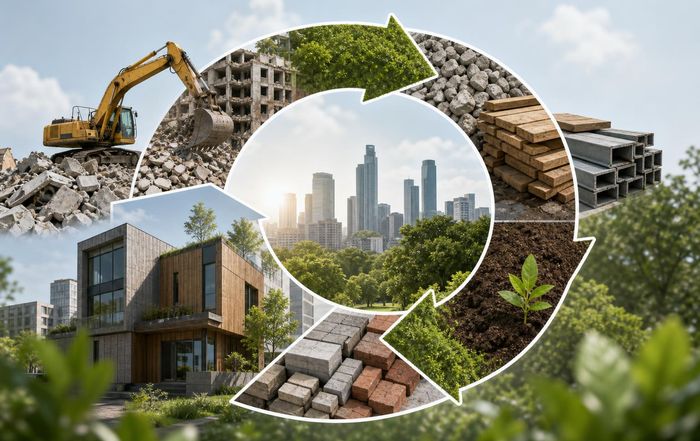
How Construction Waste Can Support a Circular Economy
Rethinking Construction Waste in a Resource-Constrained World
Around the world, the construction sector sits at the heart of a profound environmental paradox. It is indispensable for housing, infrastructure, and economic development, yet it is also one of the largest generators of waste and a major consumer of raw materials. According to the United Nations Environment Programme (UNEP), buildings and construction together account for a significant share of global material use and nearly 37 percent of energy-related carbon dioxide emissions. At the same time, the sector produces billions of tonnes of construction and demolition waste every year, much of which is still landfilled or downcycled into low-value uses.
The emerging circular economy model offers a way to transform this challenge into a powerful opportunity. Rather than treating construction waste as an inevitable by-product of growth, a circular approach views it as a valuable resource that can be designed out, recovered, and reintegrated into productive use. For our fans this shift aligns closely with broader commitments to sustainable living, responsible consumption, and regenerative design.
In this vision, buildings become material banks, demolition becomes urban mining, and construction waste becomes a catalyst for new business models, jobs, and climate solutions. Countries across Europe, North America, Asia, Africa, and South America are beginning to demonstrate how this transformation can work in practice, and how citizens, companies, and policymakers can accelerate it.
From Linear to Circular: Why Construction Waste Matters
The traditional linear model of "take-make-waste" in construction depends on extracting virgin materials such as sand, gravel, timber, metals, and cement, turning them into products, and disposing of them at the end of life. This approach has contributed to habitat loss, water stress, and pollution, as well as to the depletion of high-quality aggregates and other resources in regions from the United States and Canada to China and the European Union.
Data compiled by the Organisation for Economic Co-operation and Development (OECD) indicate that construction minerals are among the largest material flows in the global economy. Meanwhile, the European Environment Agency (EEA) reports that construction and demolition waste (CDW) is the single biggest waste stream in many European countries, often representing more than one third of total waste generated. Similar patterns are observed in the United States, where the U.S. Environmental Protection Agency (EPA) estimates that CDW volumes significantly exceed municipal solid waste.
In a circular economy, the goal is not simply to manage this waste more efficiently, but to prevent it where possible, preserve the value of materials for as long as feasible, and keep them circulating in high-quality applications. This requires a combination of design innovation, new construction techniques, advanced sorting and recycling technologies, and supportive policy frameworks. It also calls for a cultural shift in how developers, architects, contractors, and clients perceive materials and waste, moving from a cost to be minimized to an asset to be cultivated.
For Eco Natur, this reframing is central to how sustainability is communicated: construction waste is no longer an afterthought but an integral part of a regenerative built environment.
Designing Out Waste: The First Principle of Circular Construction
The most effective form of waste management is not to create waste in the first place. Circular construction therefore begins at the design stage, long before a building is erected or a single brick is laid. Architects and engineers increasingly adopt design-for-disassembly, modular construction, and material efficiency strategies that reduce offcuts, avoid unnecessary complexity, and extend the useful life of structures.
Organizations such as the Ellen MacArthur Foundation (ellenmacarthurfoundation.org) have highlighted that up to 80 percent of a product's environmental impact is determined during the design phase. In the built environment, this insight translates into decisions about structural systems, connection details, standardized dimensions, and material choices that determine how easily components can be reused or recycled decades later. For example, using mechanical fasteners instead of permanent adhesives can allow façade panels, floor systems, and interior partitions to be removed intact rather than destroyed during renovation.
Across Europe and Asia, demonstration projects show that buildings designed as "material passports" or "material banks" can retain detailed information about the origin, composition, and potential reuse of every major component. Digital tools and building information modeling (BIM) platforms are increasingly used to document these attributes, enabling future owners or deconstruction teams to recover high-value elements rather than resorting to bulk demolition. The World Green Building Council (worldgbc.org) and national green building councils in countries such as Germany, the United Kingdom, and Australia are helping to integrate such circular design principles into certification schemes and professional practice.
For readers of eco-natur, this design perspective resonates with themes already explored in areas like sustainable design and materials and zero-waste lifestyles, where the emphasis is on preventing waste at the source through thoughtful planning and product choices.
Urban Mining: Turning Demolition into Resource Recovery
Even with better design, a vast legacy of existing buildings and infrastructure will inevitably reach the end of its service life in the coming decades. The concept of "urban mining" reframes demolition as an opportunity to extract valuable materials from the built environment, much as traditional mining extracts ores from the earth. Instead of sending concrete, bricks, metals, timber, and glass to landfill, specialized companies systematically deconstruct structures and recover components for reuse or high-quality recycling.
Research by the International Resource Panel (UNEP IRP) and other expert bodies suggests that urban mining can significantly reduce the need for virgin materials, lower greenhouse gas emissions, and create new employment in sorting, processing, and remanufacturing. In countries like the Netherlands, Denmark, and Sweden, public authorities increasingly require high recovery rates for construction and demolition projects, and some cities have established dedicated material hubs that store and trade reclaimed elements such as steel beams, bricks, and timber.
In North America, organizations like RMI (rmi.org) and leading universities have documented case studies where careful deconstruction has diverted more than 90 percent of building materials from landfill, while also preserving historic architectural elements for reuse. In Asia, large metropolitan regions in Japan and South Korea have developed sophisticated CDW sorting and recycling systems, supported by regulations that mandate recycling rates and restrict landfilling.
For Eco Natur, highlighting these examples underscores how recycling and material recovery can move far beyond household waste to encompass entire buildings and infrastructure networks, turning cities into vast reservoirs of reusable resources.
Recycled Aggregates and Low-Carbon Materials
One of the most promising ways construction waste can support a circular economy is by substituting recycled materials for virgin aggregates and inputs in new construction. Crushed concrete and masonry, when properly processed and quality-controlled, can replace a significant portion of natural sand and gravel in road bases, non-structural concrete, and other applications. The European Commission (ec.europa.eu) has promoted such practices through its Construction & Demolition Waste Protocol, which provides guidance on quality standards, certification, and market development for recycled aggregates.
Similarly, recovered steel, aluminum, and copper can be remelted and reformed with substantially lower energy use and emissions than primary production. The World Steel Association (worldsteel.org) reports that steel is already one of the most recycled materials globally, and increasing recovery rates from demolition sites can further reduce the sector's environmental footprint. Glass cullet from construction and renovation can be reintegrated into new glass products or used as an aggregate in specialized building materials.
Concrete, as one of the most carbon-intensive building materials, is receiving particular attention. Researchers and companies in Europe, North America, and Asia are exploring ways to incorporate recycled concrete aggregates, industrial by-products, and even carbon capture technologies into new mixes. Initiatives supported by organizations such as the Global Cement and Concrete Association (gccassociation.org) aim to align these innovations with climate targets and circular economy principles.
For readers of eco-natur, these developments connect directly with broader discussions on renewable and low-impact materials and sustainable economic models, demonstrating that circularity can be technically robust as well as environmentally beneficial.
Circular Construction and a Plastic-Free Future
While heavy materials like concrete and steel dominate by weight, plastics play a growing role in modern construction, from insulation and piping to flooring and façade systems. Many of these plastic components are difficult to recycle because they are composite, contaminated, or bonded to other materials, leading to significant waste at end of life and contributing to global plastic pollution.
A circular construction approach aligned with Eco Natur's commitment to a plastic-free lifestyle seeks to reduce unnecessary plastic use, prioritize recyclable or bio-based alternatives, and design products for disassembly. The New Plastics Economy initiative coordinated by the Ellen MacArthur Foundation and supported by major companies and governments has called for eliminating problematic and avoidable plastic items, innovating toward reusable or recyclable designs, and ensuring that all plastics are circulated in practice.
In the construction sector, this can involve specifying mono-material plastic components that can be easily sorted and recycled, favoring mechanical fasteners over adhesives, and using digital product passports to track polymer types and additives. It can also mean substituting natural materials such as timber, cork, cellulose, and wool insulation where appropriate, drawing on research from organizations like Forest Stewardship Council (fsc.org) and PEFC International (pefc.org) to ensure that such materials are sourced responsibly.
These choices connect construction practice with the everyday decisions that eco-natur readers make about packaging, household products, and sustainable lifestyles, reinforcing the message that plastic reduction must occur at every scale, from the home to the city.
Protecting Wildlife and Biodiversity through Circular Construction
Construction waste and linear building practices have profound implications for biodiversity and wildlife. Habitat destruction, landfilling, quarrying for aggregates, and the pollution associated with material production all contribute to the loss of species and ecosystems across continents, from the forests of Brazil and Southeast Asia to wetlands in Europe and North America. Reports from the Intergovernmental Science-Policy Platform on Biodiversity and Ecosystem Services (IPBES) highlight land-use change and resource extraction as major drivers of biodiversity decline.
By reducing the demand for virgin materials and minimizing land disturbance, circular construction can help alleviate some of these pressures. Reusing bricks, timber, and metals decreases the need for new quarries and mines, while better management of construction waste reduces the pollution burden on rivers, soils, and coastal areas. In addition, designing buildings with nature in mind-incorporating green roofs, wildlife corridors, and habitat features-can create new opportunities for urban biodiversity.
Conservation organizations such as the World Wide Fund for Nature (WWF) and the International Union for Conservation of Nature (IUCN) have emphasized that infrastructure and construction decisions can either exacerbate or mitigate threats to wildlife. Integrating circular economy principles into these decisions supports more holistic approaches to biodiversity protection and wildlife conservation, themes that are central to Eco Natur's mission.
Health, Indoor Environments, and Circular Materials
The relationship between construction waste and human health is often overlooked, yet it is highly significant. Materials that are difficult to recycle may also contain hazardous substances, such as certain flame retardants, solvents, or heavy metals, which can pose risks during demolition, processing, and disposal. Ensuring that circular construction supports safe and healthy environments therefore requires careful attention to material chemistry and lifecycle impacts.
Organizations like the World Health Organization (WHO) and the International Living Future Institute (living-future.org) have documented how indoor air quality and material choices affect respiratory health, allergies, and overall well-being. Circular strategies that favor non-toxic, natural, or low-emission materials not only ease recycling but also improve the quality of indoor environments for occupants. Product transparency initiatives, such as environmental product declarations and health product declarations, are becoming more common in markets from the United States and Canada to Germany, France, and Japan.
For Eco Natur, this intersection of circularity and health aligns with its focus on healthy, sustainable living and organic, non-toxic products, reinforcing the principle that environmental and human health are inseparable.
Circular Economy as a Driver of Sustainable Business and Green Jobs
The transition from linear to circular construction is not only an environmental imperative but also a significant economic opportunity. As governments, investors, and clients increasingly demand low-carbon, resource-efficient buildings, new markets are emerging for companies that can deliver circular solutions. These include deconstruction services, material recovery facilities, digital marketplaces for reclaimed components, design consultancies specializing in circular buildings, and manufacturers of products with high recycled content.
Analyses by the International Labour Organization (ILO) and the World Economic Forum (weforum.org) indicate that circular economy strategies could create millions of new jobs globally, particularly in sectors such as repair, remanufacturing, recycling, and sustainable construction. In Europe, the Circular Economy Action Plan supports innovation and investment in these areas, while in regions such as China, South Korea, and Singapore, national policies increasingly integrate circularity into industrial and urban planning.
For Eco Natur, the business dimension of circular construction connects directly with its coverage of sustainable business models and green economic transitions. Entrepreneurs in countries from the United States and Canada to South Africa, Brazil, and New Zealand are developing platforms that match demolition projects with buyers of reclaimed materials, software that tracks material flows across supply chains, and financing mechanisms for circular building retrofits.
The construction industry's global footprint means that even incremental improvements in reuse and recycling can have large economic and environmental impacts. As more developers and financiers recognize the long-term value of resilient, low-waste buildings, circular construction is shifting from a niche innovation to a mainstream expectation.
Policy, Standards, and International Cooperation
Realizing the full potential of construction waste in a circular economy depends heavily on policy frameworks, standards, and international collaboration. Governments at local, national, and regional levels are experimenting with instruments such as landfill taxes, mandatory recycling targets, green public procurement, and building codes that favor circular design.
The European Union has been a leader in this space, with directives on waste, construction products, and energy performance that increasingly reference circular economy principles. The European Commission's Circular Economy Action Plan and Renovation Wave initiative encourage member states to prioritize resource efficiency in building renovation and to improve data on material flows. In the United States, several states and cities, including those in California and the Pacific Northwest, have adopted ordinances requiring construction and demolition waste diversion and deconstruction for certain building types, supported by guidance from the EPA and organizations like the US Green Building Council (usgbc.org).
In Asia, countries such as Japan and South Korea have implemented laws that mandate recycling rates for construction waste and regulate landfill use, while Singapore's Building and Construction Authority (bca.gov.sg) promotes the use of recycled aggregates and prefabricated, prefinished, and modular construction methods. In Africa and South America, growing urbanization presents both challenges and opportunities, with cities exploring how circular construction can support sustainable development and reduce informal dumping.
International networks, including UN-Habitat (unhabitat.org) and the Global Alliance for Buildings and Construction (globalabc.org), facilitate the sharing of best practices, data, and tools across regions. These platforms help ensure that lessons learned in Europe or North America can inform policy and practice in rapidly urbanizing regions of Asia, Africa, and Latin America, and vice versa.
For eco-natur, following these policy developments is part of its broader commitment to global sustainability perspectives, providing readers with insights that are relevant whether they live in Germany, the United Kingdom, Thailand, or South Africa.
Everyday Actions: How Individuals and Communities Can Support Circular Construction
Although much of the discussion around construction waste and circular economy focuses on large projects and institutional actors, individuals and communities also have an important role to play. Homeowners, tenants, and small businesses make decisions about renovation, maintenance, and purchasing that collectively shape market demand. Choosing contractors who prioritize reuse and recycling, asking for reclaimed materials where feasible, and supporting local deconstruction and salvage enterprises can all help expand the circular construction ecosystem.
In many cities, community organizations and social enterprises run building material reuse centers, tool libraries, and training programs that teach deconstruction skills and sustainable construction practices. These initiatives often create local jobs while making affordable materials available for low-income households, schools, and non-profits. Resources from the ICLEI - Local Governments for Sustainability network (iclei.org) and similar organizations can assist municipalities that wish to promote such community-based circular initiatives.
For Eco Natur, encouraging fans to connect these local opportunities with broader sustainable living practices and zero-waste goals is a natural extension of its existing content. Whether renovating a kitchen in Canada, building an extension in Italy, or volunteering on a community project in Malaysia, individuals can ask questions about material sourcing, waste management, and design choices that favor circular outcomes.
A Regenerative Future for the Built Environment
As the world moves further into the second half of this decade, the urgency of aligning construction with planetary boundaries becomes ever more evident. Climate change, biodiversity loss, resource depletion, and social inequality all intersect in the built environment, making it both a challenge and a powerful lever for change. Construction waste sits at the center of this intersection: a visible symptom of linear thinking, but also a tangible starting point for transformation.
By designing out waste, embracing urban mining, investing in recycled and low-impact materials, protecting wildlife and human health, and fostering innovative business models, the construction sector can become a cornerstone of the circular economy. This transition will not happen overnight, and it will require collaboration across professions, industries, and borders. Yet the momentum is growing, supported by scientific research, policy frameworks, market demand, and the creativity of architects, engineers, entrepreneurs, and communities.
For the growing audience here, this story is ultimately one of possibility and empowerment. The same ingenuity that created modern skylines and infrastructure can now be directed toward a built environment that regenerates rather than depletes, that values materials across their full lifecycle, and that integrates human prosperity with the flourishing of nature. In such a future, construction waste is no longer a burden to be hidden away, but a resource that supports resilient economies, thriving ecosystems, and healthier lives in every region of the world.
