
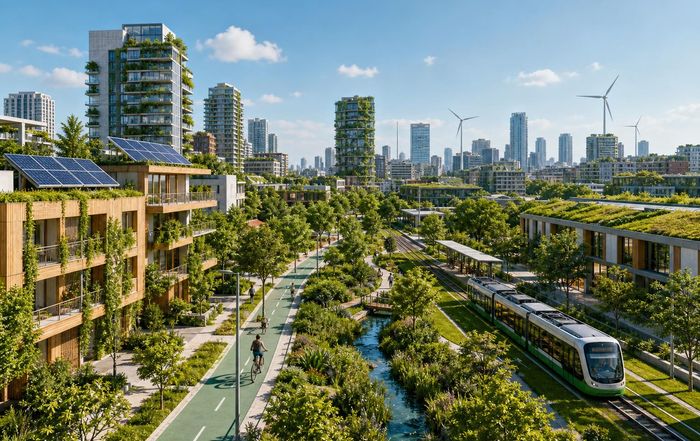
Why Sustainable Housing Needs Better Urban Planning
Rethinking the Green Home: Why Context Matters More Than Any Single Building
Across the world, sustainable housing has moved from the margins of architecture into the mainstream of policy, finance and consumer demand. Low-energy homes, net-zero buildings, green roofs and eco-certifications are now familiar concepts in cities from New York to Singapore and from Berlin to Sydney. Yet, despite impressive progress in building technology and design standards, many cities are discovering that high-performance homes alone cannot deliver the environmental, social and economic transformation societies expect. Without better urban planning, even the greenest buildings risk becoming isolated successes in unsustainable neighborhoods.
For the team here which has long emphasized the interdependence between individual choices and systemic change, this tension is central. A highly efficient apartment, if located far from public transport, jobs and services, can lock its residents into car dependency, higher emissions and social isolation. Conversely, a modestly retrofitted home in a compact, well-planned neighborhood may deliver far greater real-world sustainability benefits over its lifetime. This shift from focusing solely on the building to understanding the broader urban ecosystem is reshaping how experts think about sustainable living, housing policy and city design.
From Green Buildings to Sustainable Urban Systems
In the past two decades, voluntary building rating systems such as LEED from the U.S. Green Building Council and BREEAM from the Building Research Establishment in the United Kingdom have helped define what a "green building" looks like. They have encouraged better insulation, efficient heating and cooling, water-saving fixtures, responsible materials and on-site renewable energy. Learn more about these frameworks at the U.S. Green Building Council and BRE Group.
However, as researchers at institutions such as MIT, ETH Zurich and the London School of Economics have highlighted, the environmental performance of a building cannot be separated from its location, infrastructure and urban form. A net-zero energy home in a sprawling suburb may still be associated with high transport emissions, while a well-connected urban apartment with moderate efficiency can result in lower overall carbon footprints. Studies summarized by the Intergovernmental Panel on Climate Change (IPCC) in its Sixth Assessment Report underline that urban form, density and land-use mix can significantly influence emissions from transport, buildings and infrastructure combined. Readers can explore this analysis through the IPCC's reports.
This systemic perspective aligns with Eco Natur's view that genuine sustainability requires aligning building-level innovation with neighborhood design, city planning and regional development. The home is one node in a complex web of mobility, food systems, energy networks, biodiversity corridors and social infrastructure.
The Planning Gap: Why Good Intentions Fall Short
Many cities in North America, Europe and Asia have ambitious climate goals and housing strategies. Municipalities from Vancouver to Amsterdam have adopted climate emergency declarations and net-zero roadmaps, while national frameworks such as the European Green Deal and updated Nationally Determined Contributions under the Paris Agreement provide overarching direction. Yet, housing development often proceeds through fragmented decisions, driven by short-term market pressures and zoning rules that are slow to change.
This disconnect manifests in several recurring patterns. First, land-use plans that separate housing from employment centers, schools and amenities force residents into long commutes, particularly in the United States, Canada and parts of Australia, where postwar planning favored car-oriented suburbs. Second, restrictive zoning in many cities limits the supply of compact, multi-family housing in central areas, pushing development to the urban fringe, where services are sparse and car dependency is high. Analyses by organizations such as the OECD and World Resources Institute have documented how these trends increase infrastructure costs, energy use and emissions; further background can be found via the OECD's work on cities and climate and the World Resources Institute's urban development research.
Third, sustainability criteria are too often applied at the level of individual projects rather than integrated into long-term citywide plans. A new eco-district may feature energy-efficient buildings, green spaces and cycling infrastructure, but if it remains disconnected from regional transit networks or fails to provide affordable housing, its social and environmental impact is constrained. This is one reason why many urbanists and environmental organizations argue for stronger coordination between housing policy, transport planning, land-use regulation and climate strategies, an approach promoted by groups such as C40 Cities and ICLEI - Local Governments for Sustainability. Their guidance on climate-resilient city planning is accessible through C40 Cities and ICLEI.
Compact, Connected and Nature-Positive: The Urban Planning Principles Housing Needs
When sustainable housing is considered within a broader planning framework, several core principles consistently emerge as effective and mutually reinforcing. Although every city has its own geography, culture and governance, research and practice point toward three overarching priorities: compactness, connectivity and nature-positivity.
Compact urban form, often associated with "15-minute city" or "complete neighborhood" concepts, aims to ensure that most daily needs can be met within a short walk or cycle ride. This does not imply uniformly high-rise development, but rather a mix of medium-density housing types, such as townhouses, courtyard apartments and small multi-family buildings, interwoven with shops, schools and parks. Evidence from European cities like Copenhagen, Barcelona and Freiburg suggests that such patterns can reduce per-capita transport emissions and infrastructure costs while supporting vibrant local economies. More detailed discussions of these models can be found at organizations such as UN-Habitat, which provides global guidance on sustainable urban development through UN-Habitat's publications.
Connectivity refers to both physical and digital networks. High-quality public transport, safe walking and cycling routes, and well-designed street grids allow residents of sustainable housing to rely less on private cars, thereby lowering emissions and improving air quality. The International Transport Forum and Institute for Transportation and Development Policy have repeatedly emphasized that transit-oriented development, when combined with affordable housing policies, yields significant environmental and social co-benefits. Readers may explore case studies via the International Transport Forum and the ITDP.
Nature-positivity recognizes that sustainable housing must coexist with, and actively support, urban biodiversity, ecosystem services and climate resilience. Integrating green corridors, urban forests, wetlands and biodiversity-friendly landscaping into housing plans helps manage stormwater, mitigate heatwaves and provide habitats for wildlife. For Eco Natur, the connection between housing and biodiversity is paramount, as urban expansion remains one of the major drivers of habitat fragmentation worldwide. Organizations such as the International Union for Conservation of Nature (IUCN) and the World Wildlife Fund (WWF) provide frameworks and data on how cities can reduce their ecological footprint and support species recovery, accessible through the IUCN and WWF.
Energy, Materials and the Circular City
Better urban planning does more than improve transport and land use; it also shapes how energy and materials flow through housing systems. As countries expand renewable energy capacity, particularly solar and wind, the relationship between buildings and grids becomes more dynamic. District-scale planning can enable shared energy infrastructure, such as neighborhood microgrids, geothermal networks and community solar installations, which are often more efficient and resilient than isolated systems. Readers interested in these trends can refer to the International Energy Agency (IEA) for analysis of buildings and cities in the energy transition via the IEA's buildings sector insights.
At the same time, the construction sector is responsible for significant material use and waste, from concrete and steel to plastics and glass. Urban planning that supports compact development, adaptive reuse of existing buildings and circular economy strategies can dramatically reduce the need for new materials and lower lifecycle emissions. The Ellen MacArthur Foundation and the World Green Building Council have both highlighted the importance of circular design, modular construction and urban mining in achieving climate and resource goals, offering detailed resources through the Ellen MacArthur Foundation and the World Green Building Council.
For Eco Natur, which advocates recycling and zero-waste lifestyles, the idea of a circular city resonates strongly. Sustainable housing should be designed not only for operational efficiency but also for disassembly, repair and material recovery at the end of its life. This requires planners, architects, developers and regulators to coordinate building codes, zoning and waste management policies, ensuring that the physical fabric of cities becomes a long-term material bank rather than a one-way flow to landfills.
Social Equity, Affordability and the Right to the Sustainable City
A critical reason why sustainable housing needs better urban planning lies in questions of equity and justice. In many global cities, environmentally advanced housing has been marketed as a premium product, accessible mainly to higher-income households. Meanwhile, low-income communities often live in older, inefficient buildings located in areas with poor public transport, limited green space and greater exposure to pollution or climate hazards such as flooding and heatwaves.
Urban planning that integrates sustainability with social policy can help reverse this pattern. Inclusionary zoning, social housing programs, rent controls, community land trusts and cooperative housing models are among the tools that cities in Europe, North America and Latin America are experimenting with to ensure that low- and middle-income residents benefit from green upgrades and new developments. Organizations such as Habitat for Humanity and Cities Alliance document how these approaches can be aligned with climate resilience and energy efficiency goals; further reading is available from Habitat for Humanity and Cities Alliance.
The concept of a "right to the city," originally articulated by scholars such as Henri Lefebvre and expanded by contemporary urban movements, has influenced debates in countries from Brazil to South Africa and from France to the United States. It emphasizes that all residents, not only property owners or investors, should have a voice in how their neighborhoods evolve. For Eco Natur, which connects environmental responsibility with human well-being and health, this principle underscores that sustainable housing must also be democratic housing, shaped through participatory planning, community engagement and transparent governance.
Plastic-Free, Organic and Local: Everyday Life in Sustainable Neighborhoods
Sustainable housing is not only about buildings and infrastructure; it is also about daily habits, cultural norms and economic opportunities. Better urban planning can create the conditions in which low-impact lifestyles become convenient, desirable and affordable. This is particularly visible in efforts to reduce plastic pollution, promote organic food and support local economies.
Cities across Europe, Asia and the Americas have introduced regulations on single-use plastics, expanded deposit-return schemes and invested in reuse and refill systems. When these policies are integrated into neighborhood design-through well-located refill stations, community composting sites, farmers' markets and accessible recycling points-they can enable residents of eco-homes to live more plastic-free and circular lifestyles with minimal effort. Organizations such as the UN Environment Programme (UNEP) and the OECD provide data and policy guidance on plastic reduction and waste management, accessible via UNEP and the OECD's waste and materials pages.
Similarly, urban planning that preserves peri-urban farmland, supports food hubs and short supply chains, and allocates space for community gardens can strengthen sustainable food systems. Residents in well-designed eco-districts often have easier access to fresh, local and organic produce, reducing both transport emissions and reliance on heavily packaged, ultra-processed foods. The Food and Agriculture Organization (FAO) and networks such as RUAF Global Partnership on Sustainable Urban Agriculture and Food Systems offer extensive case studies on city-region food planning, which readers can explore through FAO and RUAF.
For Eco Natur, these developments illustrate how sustainable housing, when embedded in supportive urban environments, becomes a platform for a broader lifestyle shift. Efficient appliances, renewable energy and good insulation are important, but so too are walkable streets, vibrant local businesses, cultural spaces and community networks that make sustainable choices the default.
Wildlife, Green Corridors and the Living City
One of the most inspiring trends in urban planning is the growing recognition that cities can be habitats not only for humans but also for a rich diversity of species. While urbanization has historically been associated with habitat loss and species decline, innovative planning approaches are beginning to reverse this trend in some regions. Green belts, river restoration projects, wildlife crossings, pollinator-friendly planting and nature-inclusive design in buildings are all contributing to a new vision of the living city.
Initiatives such as the Singapore "City in Nature" strategy, the rewilding of parts of London's Thames corridor and the expansion of green roofs and walls in cities like Basel and Paris demonstrate how urban areas can support birds, insects, amphibians and small mammals. Conservation organizations and academic research, including work by the IUCN Urban Alliance and universities in Sweden, the Netherlands and the United States, have documented the ecological benefits of these interventions, as well as their contributions to mental health and climate resilience. For more information, readers can consult the IUCN Urban Alliance and research summaries from institutions such as Stockholm Resilience Centre at stockholmresilience.org.
For Eco Natur, which highlights the importance of wildlife and ecosystem health, this integration of biodiversity into urban planning is essential for sustainable housing. A building that meets energy standards but is surrounded by impermeable surfaces, devoid of trees or native vegetation, does little to support pollinators, migratory birds or urban cooling. By contrast, housing developments that incorporate green roofs, nesting sites, permeable pavements and connections to larger green corridors can play a meaningful role in regional conservation strategies.
Sustainable Business, Green Finance and the Urban Economy
The transformation of housing and urban planning is closely linked to evolving economic models and business practices. Real estate developers, construction firms, investors and technology companies are increasingly engaging with environmental, social and governance (ESG) frameworks, green taxonomies and climate disclosure requirements. When aligned with robust planning, these financial and corporate shifts can accelerate the deployment of sustainable housing at scale.
Organizations such as the World Bank, the International Finance Corporation (IFC) and regional development banks have expanded green building finance programs, often tied to urban regeneration or affordable housing initiatives. Their guidance on sustainable business practices and climate-resilient infrastructure is publicly available through resources like the World Bank's climate and cities pages and the IFC's EDGE green building platform. At the same time, rating agencies and investors are paying closer attention to climate risks such as flooding, heat stress and sea-level rise, which directly affect housing assets and urban land values.
In this context, better urban planning becomes a form of risk management and value creation. Compact, transit-oriented, nature-positive neighborhoods are not only lower in emissions; they are also more resilient to climate impacts, more attractive to residents and businesses, and often more fiscally sustainable for municipalities. For Eco Natur, which explores the intersection of sustainability and the economy, these developments illustrate how environmental responsibility and long-term economic health can reinforce each other when guided by thoughtful planning.
Global Diversity, Shared Challenges
While the principles of sustainable housing and integrated urban planning are increasingly recognized, their application varies widely across regions and income levels. In rapidly urbanizing parts of Asia and Africa, where millions of new homes are being built each year, the challenge is to avoid locking in car-dependent sprawl and resource-intensive construction. In many cases, informal settlements and self-built neighborhoods already house large portions of the population, raising complex questions about upgrading, tenure security and infrastructure provision.
Organizations such as UN-Habitat, the World Bank and regional bodies in Africa, Asia and Latin America emphasize that sustainable urban planning must be context-sensitive, inclusive and grounded in local governance capacities. At the same time, they highlight that early decisions about urban form, transport corridors and land-use regulations have long-lasting consequences for emissions, air quality, public health and social equity. Readers can learn more about these dynamics through UN-Habitat's global reports and the World Bank's work on sustainable cities.
In higher-income regions such as Europe, North America and parts of East Asia, the focus often lies on retrofitting existing building stock, densifying under-utilized land, and reconfiguring transport systems to prioritize public and active modes. Countries such as Germany, Sweden, the Netherlands and Japan have developed advanced building codes and energy standards, but many still grapple with housing affordability and local opposition to densification. This underscores that technical solutions alone are insufficient; political leadership, community engagement and cultural shifts are equally important in aligning housing with sustainable urban planning.
Our Perspective: Linking Home, Neighborhood and Planet
Sustainable housing is not an isolated product or a set of technical features, but a living interface between individuals, communities and the planet. A well-insulated apartment with solar panels is valuable, yet its true impact unfolds only when it is part of a walkable neighborhood, connected to clean transport, embedded in a circular economy and surrounded by thriving biodiversity. This holistic view is reflected in the daily stories of renewable energy, design, global sustainability trends and everyday practices that make low-impact living achievable.
As cities in the United States, Europe, Asia, Africa, South America and beyond navigate the intertwined crises of climate change, housing affordability, biodiversity loss and social inequality, the integration of sustainable housing into better urban planning emerges as both a necessity and an opportunity. It is a necessity because fragmented, car-dependent, resource-intensive development is no longer compatible with planetary boundaries or public health. It is an opportunity because reimagining neighborhoods can unlock new forms of community, creativity and well-being that go far beyond reducing emissions.
The coming years will likely see increasing alignment between climate policy, housing regulation, financial frameworks and community activism. Digital tools, data platforms and participatory planning methods are making it easier for residents to understand the impacts of different urban scenarios and to contribute their knowledge and aspirations. International frameworks, from the Paris Agreement to the New Urban Agenda, provide shared reference points, while local experiments in cities across continents offer practical models that can be adapted and scaled.
In this evolving landscape, Eco Natur will continue to highlight stories of innovation, resilience and collaboration, emphasizing that truly sustainable housing is not just about where people live, but about how urban societies choose to organize space, share resources and care for the natural world. By linking the home to the neighborhood and the city to the biosphere, better urban planning can turn sustainable housing from a niche aspiration into a foundation for thriving, equitable and regenerative communities worldwide.
