
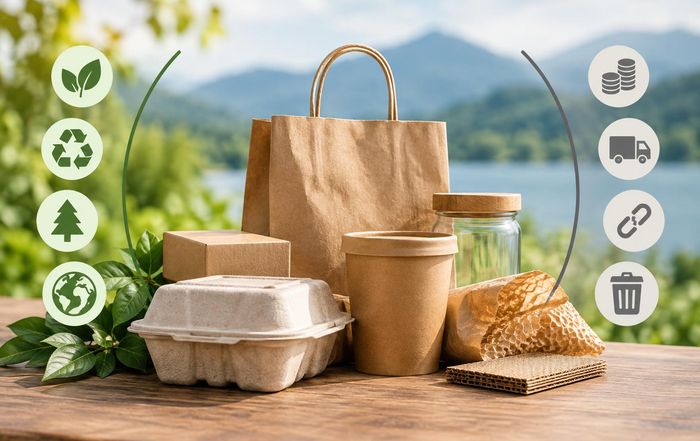
Sustainable Packaging Materials: Benefits and Trade-Offs
Packaging has become one of the most visible tests of whether a product is genuinely designed for lower environmental impact or simply marketed that way. For brands, retailers, and households, the appeal of sustainable packaging is straightforward: less waste, lower fossil-fuel dependence, and a better fit with growing expectations around responsible consumption. But the subject is more complicated than swapping plastic for paper or choosing a compostable label. The environmental profile of packaging depends on what it is made from, how much material is used, how it is transported, whether it can actually be recycled or composted where it is sold, and what happens after use. That is why the most useful way to think about sustainable packaging is not as a single material choice, but as a set of trade-offs that must be evaluated case by case.
The policy and industry context matters. Governments and standards bodies are pushing harder on waste reduction, recyclability, and extended producer responsibility, while companies are trying to cut emissions without compromising product safety or shelf life. Organizations such as the United Nations Environment Programme, the European Commission, the U.S. Environmental Protection Agency, and WRAP have all helped shape the current conversation by emphasizing that packaging should be judged across its full life cycle rather than by a single attribute. That life-cycle view is especially important in food, personal care, and e-commerce, where packaging can prevent spoilage, reduce damage, and lower the total footprint of a product even when the package itself is not perfect. Visitors interested in the wider systems side of the issue may also find Eco Natur's daily educational content of sustainability and zero waste useful for understanding how packaging fits into a broader reduction strategy.
What makes packaging "sustainable" in practice
A sustainable packaging material is usually one that reduces environmental harm across its life cycle compared with conventional alternatives. That can mean using recycled feedstock, renewable raw materials, less energy-intensive production, lighter formats, or designs that improve reuse and recovery. It can also mean avoiding unnecessary layers, simplifying labels and adhesives, and choosing formats that are actually collected and processed in the regions where they are sold. In other words, sustainability is not only about material origin; it is also about system compatibility.
This is where the distinction between recyclable, recycled, compostable, and biodegradable becomes important. A package may be technically recyclable but still fail in practice if local infrastructure does not accept it or if it is made of mixed materials that are difficult to separate. Compostable packaging can be useful in specific settings, especially where food contamination makes recycling impractical, but it only works as intended when appropriate composting facilities exist. The Biodegradable Products Institute and the European Bioplastics organizations both reflect how much of the market depends on accurate standards and clear end-of-life pathways. For a broader consumer-facing overview of waste handling and material recovery, Eco Natur's recycling and plastic-free pages provide helpful background.
Paper and cardboard: familiar, versatile, and not automatically low-impact
Paper-based packaging is often treated as the default sustainable option because it is renewable, widely recognized, and usually easier for consumers to sort correctly than many composite formats. Corrugated boxes, molded fiber trays, paper bags, and cartonboard can all perform well when they are designed to use recycled content and avoid unnecessary coatings. Paper also tends to have strong collection systems in many markets, which improves its practical recovery rate. For e-commerce and shipping, it can be especially attractive because it is lightweight, printable, and easy to resize to the product.
Yet paper is not impact-free. Virgin paper production can drive land-use pressure, water use, and chemical processing impacts, which is why certification and responsible sourcing matter. The Forest Stewardship Council and the Programme for the Endorsement of Forest Certification are among the best-known systems used to signal more responsible forest management, though certification is not a substitute for reducing overall material use. Paper packaging can also become less recyclable if it is heavily laminated, waxed, or coated with plastic barriers. That trade-off is common in food packaging, where moisture and grease resistance are essential. In those cases, the environmental gain from switching to paper may be smaller than expected, especially if the package is too complex to recycle efficiently. For readers exploring how design choices affect outcomes, Eco Natur's design section is a useful companion to this discussion.
Recycled plastics: often the most practical improvement, but not a complete solution
Using recycled plastic, especially post-consumer resin, is one of the most effective ways to reduce the footprint of packaging without changing product performance too drastically. For many categories, recycled content can lower demand for virgin fossil-based feedstock and help create a market for collected waste. It is particularly valuable in bottles, tubs, trays, and some flexible formats where the package must remain durable, lightweight, and moisture-resistant. In many cases, the most realistic sustainability gain comes not from eliminating plastic entirely, but from making plastic packaging more circular.
Still, recycled plastic has limits. Supply is uneven, quality can vary, and food-contact applications require strict safety controls. The U.S. Food and Drug Administration and the European Food Safety Authority both play important roles in assessing materials intended for food contact, and their requirements shape what can be done safely at scale. Recycled plastic also does not solve the litter problem if collection systems are weak or if the package is too small, too dark, or too composite to sort effectively. In addition, not all plastics are equally recyclable, and some formats are still difficult to process economically. That is why packaging strategies that rely on recycled content should usually be paired with design-for-recycling principles and clear disposal instructions rather than treated as a standalone fix. Eco Natur's sustainable living and sustainable business pages both connect these material choices to broader consumer and corporate behavior.
Bioplastics and compostables: promising in theory, selective in practice
Biobased plastics and compostable materials have attracted a lot of attention because they appear to offer a cleaner alternative to conventional plastic. Some are made from renewable feedstocks such as corn, sugarcane, or cellulose, and some are designed to break down under industrial composting conditions. In the right application, this can be useful. Food-soiled items, produce stickers, and certain serviceware formats may benefit when recovery through recycling is unrealistic. The appeal is strongest when the product is likely to enter an organics stream rather than general waste.
The challenge is that these materials are often misunderstood. "Biobased" does not automatically mean compostable, and "compostable" does not mean it will safely disappear in the environment. Many compostable plastics require controlled industrial conditions, and if they end up in standard recycling streams they can create contamination. Public confusion is one reason regulators and standards bodies have become more cautious about vague environmental claims. Organizations such as the U.S. Federal Trade Commission and the Competition and Markets Authority have both taken a harder line on green claims in recent years, making clear that packaging marketing should match real-world performance. Consumers interested in this area should also note that compostable packaging is only as effective as the collection and treatment infrastructure around it; without that infrastructure, it may offer little benefit over a simpler recyclable format.
Glass, metal, and the importance of reuse
Glass and metal are often favored because they can be recycled repeatedly without the same quality loss seen in many plastic streams. Aluminum, in particular, is valuable because recycled aluminum usually requires far less energy than primary production, and the material is widely recovered in many markets. Steel and tinplate also perform well in established recycling systems. Glass offers excellent product protection and is chemically stable, which makes it useful for beverages, condiments, cosmetics, and premium food products.
Even so, these materials are not automatically the best choice. Glass is heavy, which raises transport emissions and can make breakage more likely. Metal can be energy-intensive to produce if it is not recycled. The strongest environmental case for these materials often comes when they are reused, not just recycled. Refillable glass bottles, deposit-return systems, and returnable transport packaging can dramatically improve performance if logistics are efficient and the containers are actually cycled many times. That is why reuse is increasingly central to policy discussions in Europe and elsewhere. The World Resources Institute and the Ellen MacArthur Foundation have both helped mainstream the idea that circular systems often outperform one-way disposal models when the surrounding infrastructure is strong enough. For readers interested in the practical side of low-waste systems, Eco Natur's lifestyle and global sections offer useful context.
The hidden costs of "better" materials
One of the most common mistakes in packaging debates is assuming that a more natural-looking material is always the lower-impact choice. In reality, substitution can simply move the burden elsewhere. A thicker paper package may require more raw material and energy than a lightweight plastic one. A compostable film may reduce fossil dependence but perform worse in terms of barrier protection, leading to more food waste. A reusable container may be excellent in theory but underperform if it travels long distances empty or is washed inefficiently. These are not edge cases; they are central to how packaging should be assessed.
Food waste is especially important because the environmental cost of producing food is often much higher than the cost of the packaging around it. In many cases, packaging that extends shelf life or prevents contamination has a net environmental benefit even if the package itself is not ideal. That is why credible sustainability analysis should consider the whole product system, not just the package material. The Food and Agriculture Organization and the World Health Organization both underscore the importance of safe, stable food systems, which packaging supports by reducing spoilage and protecting public health. This systems perspective is also relevant to organic and minimally processed products, where shelf-life and contamination prevention can determine whether a product remains viable long enough to be consumed.
How businesses and consumers can judge packaging more realistically
For businesses, the most responsible approach is usually to start with reduction. Use less material, eliminate unnecessary components, and choose the simplest format that still protects the product. Then evaluate whether recycled content, mono-material design, reuse, or certified fiber can improve the package's environmental profile. If compostable materials are considered, they should be reserved for use cases where composting infrastructure is available and contamination is likely. Claims should be specific, evidence-based, and aligned with the disposal systems in the markets where the product is sold.
Consumers can make better decisions by looking beyond labels. A package that says "eco-friendly" is not necessarily better than one that is plain but highly recyclable. The most useful questions are practical ones: Can this be reused? Is it accepted locally for recycling? Does it contain recycled content? Is it overpackaged? Does the package protect the product well enough to avoid waste? Those questions are often more revealing than the material name alone. When a company explains its packaging choices clearly, that is usually a good sign; when it relies on vague green language, caution is warranted. For shoppers trying to build more sustainable routines, Eco Natur's expert content of organic food and wildlife can help connect everyday purchasing decisions to wider environmental outcomes.
The most honest conclusion is that no single packaging material wins in every category. Sustainable packaging is a design problem, a logistics problem, and a waste-management problem at the same time. The best options are usually the ones that reduce material use, fit existing recovery systems, protect the product efficiently, and avoid misleading claims. That combination is harder to achieve than a simple material swap, but it is also the only route that consistently holds up once the package leaves the shelf.
